
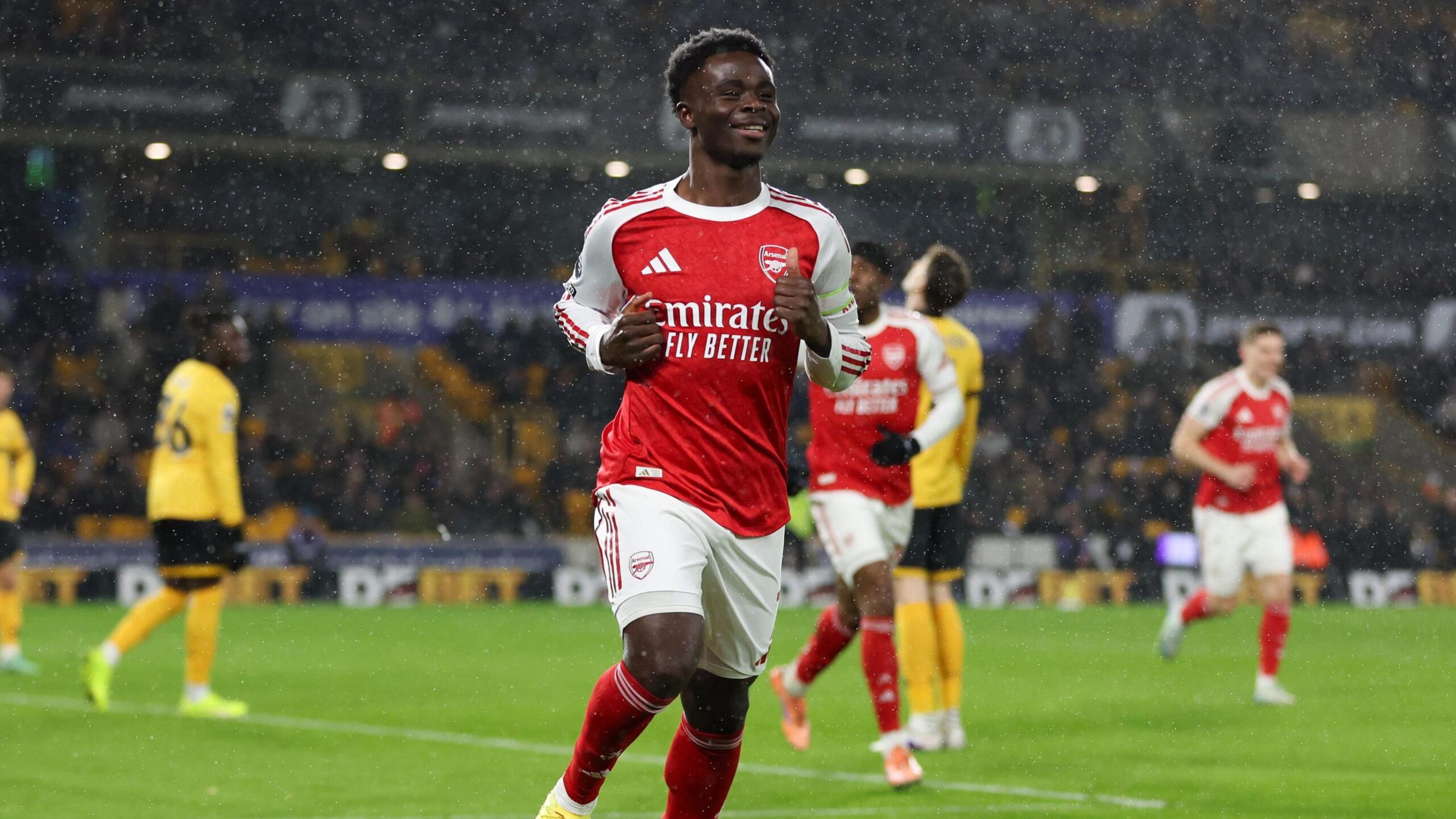
Arsenal’s Premier League title challenge took a painful hit at Molineux after Mikel Arteta’s side threw away a 2–0 lead to draw 2–2 with bottom-placed Wolverhampton Wanderers. The result did not just cost Arsenal two points. It also reopened the familiar debate about whether this squad can handle the decisive moments of a title run-in—or whether the “bottle” label will return at the worst possible time.
A dominant start, then a damaging collapse
For much of the night, Arsenal looked like a team ready to win ugly and win often—an essential trait for champions. They struck early when Bukayo Saka scored in the fifth minute, giving the league leaders control and quieting the home crowd almost immediately. When Piero Hincapié doubled the advantage in the 56th minute—his first goal for Arsenal—it felt like the match had moved into “game management” territory.
Instead, Arsenal lost their grip on the contest. Wolves found hope through Hugo Bueno’s outstanding curling effort from distance in the 61st minute, a goal that flipped the emotional temperature of the stadium and the match. From that point on, Arsenal’s performance became increasingly passive, and Wolves’ belief grew with every minute.
The equaliser arrived in the 94th minute in chaotic fashion. A defensive mix-up involving David Raya and Gabriel allowed 19-year-old Tom Edozie—on his senior Premier League debut—to pounce and fire a shot that ended up going in off Riccardo Calafiori. The moment was dramatic, but the underlying issue for Arsenal was more worrying: once Wolves applied pressure, Arsenal struggled to regain control.
“Bottle” narrative returns — and Arsenal know why
In the immediate aftermath, the language around Arsenal was predictably unforgiving. Former Arsenal striker Alan Smith said the word “bottle” would be used repeatedly in the coming days, reflecting how quickly a single result can reshape a title conversation when old scars exist.
Arteta did not try to hide from the criticism. He accepted that the team’s standards dropped and stressed that any outside opinion is fair when performances fall below the required level. In other words: Arsenal invited the scrutiny by failing to finish the job.
Saka’s post-match comments followed the same theme. He highlighted the “big difference” between Arsenal’s first-half authority and their second-half drop-off, admitting the team “dropped our standards big time” and were punished for it. For a side chasing the Premier League title, that is the type of honesty you want—but it also underlines that this was not bad luck. It was a performance problem.
Is the Premier League title now in Manchester City’s hands?
This is where the title race becomes brutally simple.
If Manchester City win all of their remaining league matches—including their home fixture against Arsenal at the Etihad—then City will finish top. That reality is what people mean when they say the title is “in Man City’s hands.” Arsenal can still win the league, but they no longer control every variable after dropping points in back-to-back draws.
At the same time, it is important to be precise: Arsenal are not “out of it,” and their destiny is not completely gone. They still have a direct meeting with City at the Etihad, and winning that game would obviously reshape the run-in. But results like the Wolves draw reduce Arsenal’s margin for error and increase the pressure on every remaining fixture.
Wolves’ role: pressure, belief, and a debut to remember
Wolves deserve credit too. Rob Edwards’ team were bottom of the table, yet they showed real spirit to keep pushing after going two down. Their comeback was not a fluke of one moment—it was driven by Bueno’s strike, the crowd’s energy, and a willingness to play on the edge of belief.
Edozie’s late goal will be remembered as a dream debut, but it also reflects something that often decides title races: the “small” errors under stress. One miscommunication at the back can undo 90 minutes of work, and Arsenal allowed that door to open.
What happens next: Tottenham, Chelsea, and a new manager bounce risk
Arsenal’s schedule does not offer much time to reset emotionally. The next major test is the north London derby away to Tottenham Hotspur—now led by Igor Tudor, who was officially appointed on Saturday 14 February 2026 to coach until the end of the season (subject to work permit). Tottenham confirmed Tudor’s first day at the training ground was Monday 16 February 2026, with immediate focus on preparing for the derby. That kind of mid-season change can create a classic “new manager bounce,” especially in a rivalry match.
For Arsenal, the message is clear: if they want to prove they are mentally ready to win the Premier League title, the response must be immediate, controlled, and ruthless—starting with the basics Arteta referenced and the intensity that disappeared after halftime at Molineux.

