
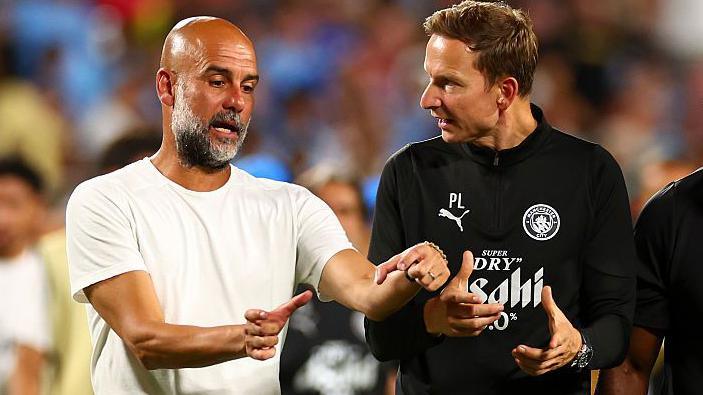
Pep Talks: How Klopp’s Ex-Assistant Is Shaping Manchester City’s Future
Manchester City’s summer spending spree made waves, with over £150 million invested in five new signings. Yet, the most transformative addition to Pep Guardiola’s squad didn’t cost a penny—and won’t kick a single ball on matchday.
In June, Pep Lijnders, the tactical architect behind Jürgen Klopp’s Liverpool revolution, arrived at the Etihad as Guardiola’s assistant. While the move slipped under the radar, its impact could reshape Manchester City’s identity in the coming seasons.
The Tactical Genius Behind the Scenes
Lijnders wasn’t just a coach at Liverpool—he was Klopp’s right-hand man, the driving force behind their high-pressing, vertical attacking style. His arrival at City suggests Guardiola is preparing a bold tactical shift, blending his own philosophy with Klopp-esque intensity.
What makes this partnership fascinating is the contrast between the two managers. Guardiola’s system is built on structured positional play, prioritizing possession and control. Klopp, on the other hand, thrives on chaos—relentless pressing, rapid transitions, and aggressive attacking play.
Yet football is evolving, and so is Guardiola. The Catalan manager has increasingly incorporated elements of pressing and directness into his tactics. With Lijnders now in the dugout, Manchester City’s evolution could accelerate.
The Rise of High-Intensity Football
Guardiola himself acknowledged the shift in modern football, telling TNT Sports:
> Today, modern football is the way Bournemouth, Newcastle, Brighton, and Liverpool play. Modern football is not just about positional play—you have to ride the rhythm.
This was a surprising admission from a manager who built his legacy on meticulous control. But the numbers back him up:
– Declining Possession Dominance: City’s average possession dropped from 65.5% to 61.3% over the past two seasons.
– More Direct Play: Fast breaks increased by 36%, from 22 to 30 per match.
– Higher Pressing Intensity: The Premier League’s overall PPDA (passes per defensive action) has decreased, signaling a league-wide shift toward aggressive pressing.
Guardiola’s transfer strategy reflects this shift. New signings like Omar Marmoush, Rayan Cherki, and Tijjani Reijnders are direct, dribble-heavy players—departing from City’s traditional focus on possession-based midfielders.
A Klopp-Inspired Revolution at City
Marmoush’s January arrival was the first sign of change. The Egyptian winger, who impressed at Wolfsburg, thrives on carrying the ball forward and disrupting defensive lines with his dribbling.
Cherki and Reijnders, signed from Lyon and AC Milan, follow the same blueprint. Compared to City’s earlier midfielders, they excel in:
– Progressive carries (driving the ball 5+ meters toward goal)
– Dribble attempts (breaking defensive lines with individual skill)
Even in defense, Guardiola is embracing aggression. The signing of Rayan Aït-Nouri—a dynamic, attack-minded left-back—marks a drastic change from City’s previous preference for conservative full-backs. Last season, Aït-Nouri ranked:
– 2nd in successful dribbles (63) among Premier League defenders
– 6th in progressive carries (89)
– Top 3 for goal contributions (11), expected assists (5.5), and touches in the opposition box (96)
His arrival signals Guardiola’s willingness to sacrifice some control for verticality—a core principle of Klopp’s philosophy.
What’s Next for Manchester City?
With Lijnders shaping training sessions and Guardiola fine-tuning the vision, the 2025-26 season could see Manchester City adopt a radically different approach. Key questions remain:
– How will Aït-Nouri and Jérémy Doku combine on the left flank? Their overlapping directness could make City unstoppable in transition.
– Where will Cherki and Marmoush fit into an already stacked attack? Guardiola may need tactical tweaks to harness their explosiveness.
– Will City fully embrace rapid transitions over possession dominance? If so, could this be the biggest evolution under Guardiola yet?
Conclusion: A New Era of Pep Talks
For years, Manchester City defined football with structured, controlled dominance. But with Lijnders now alongside Guardiola, the club might embrace a bolder, faster, and more chaotic identity.
This isn’t just a tweak—it’s a potential reinvention. And if their partnership succeeds, Pep’s pep talks with Lijnders could lead to Manchester City’s most exciting era yet.
