Rusty or Something More? South Africa’s Concern After Heavy Australia Defeat
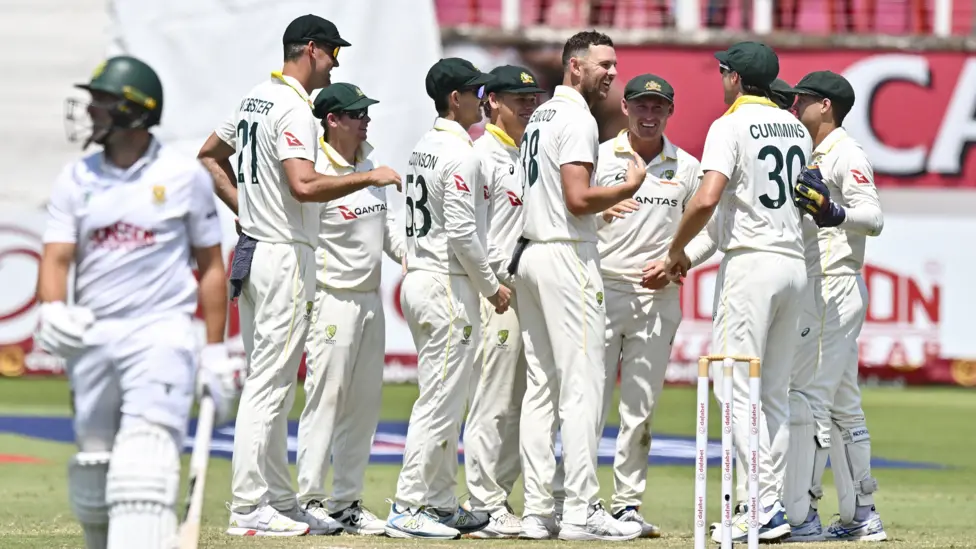
South Africa’s long unbeaten run in Test cricket came to an abrupt end in Durban as Australia claimed a commanding 214-run victory in the first Test of the series. The world champions were outclassed across five days at Kingsmead, raising immediate questions about whether the performance reflected simple rust after a long break from the longest format or deeper issues that demand attention before the second Test.
Australia posted 390 in their first innings, recovered from 124 for six thanks largely to Matt Renshaw’s career-best 190, then declared their second innings at 314 for six. South Africa managed 284 and 206 in reply. Josh Hazlewood produced career-best figures of six for 49 on the final day to seal the result, finishing off any lingering resistance after Aiden Markram’s determined 75 from 237 balls.
End of a 12-Match Unbeaten Streak
The defeat marked South Africa’s first loss in 12 Tests and the first reverse under captain Temba Bavuma since he took charge in February 2023. That sequence had included a World Test Championship final triumph and a series victory in India. The Proteas had not played a Test since November 2025, leaving them with limited recent match practice in the red-ball game.
Coach Shukri Conrad did not hide his disappointment. “I would like to see more fight,” he said. “I don’t know if it is alarming [but] it is concerning.” The comment captured the mood inside the South African camp after a match in which they were dominated with both bat and ball for long periods.
Bavuma was equally frank. He rejected the idea of using rust as a full excuse while acknowledging the long gap between Tests. “I can’t sit here and use that as an excuse,” the captain said. “You can never really prepare for Test cricket without playing Test cricket. But a lot of the mistakes we made out there were mental, so I think that’s where we really let ourselves down.” He added that the team lacked sufficient fight and mental aptitude in the second innings once Australia had seized control.
Batting Frailties and Soft Dismissals
South Africa’s batting offered the clearest cause for concern. Only Markram passed fifty in either innings. David Bedingham made scores of 48 and 46, yet too many other batters fell in the twenties and thirties. Soft dismissals and questionable shot selection featured repeatedly. Spinner Keshav Maharaj later pointed to self-inflicted damage through poor decision-making.
The inability to convert starts proved costly. Australia’s experienced pace attack, led by Pat Cummins, Mitchell Starc and Hazlewood, consistently applied pressure. Once the second new ball became available on the final day, South Africa lost their last four wickets for just five runs. The collapse underlined a lack of resilience when the game reached its critical phase.
Bowling and Spin Concerns
South Africa’s bowlers also struggled to maintain their usual standards. Although they reduced Australia to 124 for six on the opening day, they allowed the lower order—particularly the Renshaw-Cummins and Renshaw-Lyon partnerships—to rebuild the innings comprehensively. Conrad later admitted the spinners were “not as sharp as they normally are.”
The absence of Kagiso Rabada was felt, yet the home side still possessed enough quality to expect better. Anrich Nortje’s return to Test cricket after a long absence brought mixed results, while the overall intensity failed to match Australia’s sustained control.
Looking Ahead to Gqeberha
The second Test begins in Gqeberha in only five days. South Africa must decide whether the Durban performance was an isolated case of rust that the match itself has shaken off, or evidence of more significant shortcomings in batting application, bowling consistency and mental toughness.
Bavuma insisted conversations would take place and that standards must improve. Selection changes remain possible if players fail to deliver. Australia, buoyed by Renshaw’s outstanding contribution of 272 runs in the match and Hazlewood’s finishing masterclass, head into the next fixture with a 1-0 lead and growing confidence.
For South Africa, the coming days will test whether the concern expressed by Conrad and Bavuma translates into a sharper, more determined response. The world champions have little time to answer the questions their first defeat in nearly a year has raised. A stronger showing in Gqeberha is now essential if they are to prevent the series from slipping away and restore belief before a busy period that includes a home series against England later in the year.
Follow for real-time match analysis!🚀
Discover more from DeeplyticAI
Subscribe to get the latest posts sent to your email.