
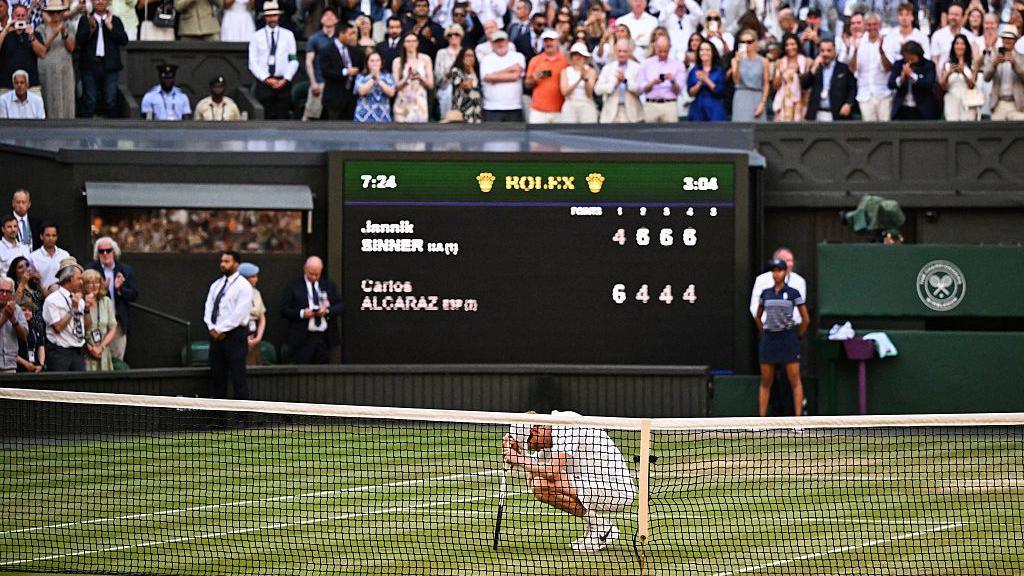
Everything Except Easy – How Jannik Sinner Conquered Wimbledon
Three championship points—one step from victory. Jannik Sinner had been here before. Just 35 days earlier, he stood on the red clay of Roland Garros, moments away from clinching the French Open title. But destiny had other plans. Carlos Alcaraz staged an epic comeback, leaving Sinner heartbroken.
Now, on the hallowed grass of Wimbledon, the Italian found himself facing the same opponent with the same stakes—only this time, he refused to let history repeat itself. With a final, decisive forehand, Sinner collapsed to his knees in triumph, arms outstretched to the sky. The roar of the Centre Court crowd echoed his relief and joy.
Only me and the people close to me know what we’ve been through on and off the court, Sinner reflected afterward, his voice steady but his emotions bare. It has been everything except easy. Even if I don’t cry, this is very emotional. To share this with my family—it’s the most amazing thing that could have happened.
Overcoming French Open Heartbreak
The road to Wimbledon glory was paved with pain. The loss in Paris could have broken Sinner—a crushing collapse after leading by two sets and holding three championship points against Alcaraz. For lesser players, such a defeat might have lingered for months. But Sinner is not an ordinary player.
Instead of wallowing, he gave himself just three days to recover. He surrounded himself with family, played ping-pong, and even hosted barbecues—simple pleasures that helped him reset. Then, arms wrapped in tape and mind sharpened by resolve, he returned to the practice courts. His ability to bounce back wasn’t just physical; it was mental.
Today was important for many reasons, admitted Darren Cahill, one of Sinner’s coaches. He needed that win. He knew the importance of closing this one out.
And close it out, he did. After enduring a five-match losing streak against Alcaraz, Sinner finally turned the tables at the tournament that mattered most.
The Grueling Path to Wimbledon Victory
Sinner’s preparation for Wimbledon wasn’t flawless. A second-round exit in Halle—his only grass-court warm-up event—raised doubts. Falling to Alexander Bublik marked his earliest tournament departure in 20 months. But rather than panic, Sinner and his team used the loss as fuel.
By the time he arrived at Wimbledon, something had clicked. Coach Cahill described their practice week as awesome, and it showed. Sinner bulldozed through the early rounds, surrendering just 17 games in his first three matches. But his title run was far from straightforward.
A brutal fourth-round clash against Grigor Dimitrov pushed him to the brink. Down two sets, Sinner’s resolve was tested like never before. He clawed his way back, ultimately advancing after Dimitrov retired with an injury. Then came a painful elbow injury from a mid-match fall—yet another obstacle. Still, he persevered, dismantling Ben Shelton and Novak Djokovic in straight sets to reach the final.
Emotionally, it took a lot, Sinner admitted. I had a tough loss in Paris. But it doesn’t matter how you win or lose—you have to learn. We accepted the loss and kept pushing. That’s why I’m holding this trophy now.
Challenges Beyond the Court
Sinner’s journey to Wimbledon wasn’t just about on-court battles. Earlier in the year, he served a three-month doping ban after a banned substance, clostebol, was detected in his system. While the World Anti-Doping Agency (WADA) cleared him of intentional wrongdoing—attributing it to his team’s oversight—the suspension cast a shadow over his stellar season.
Shortly before the ban, he had successfully defended his Australian Open title, further cementing his place among tennis’ elite. The French Open remained the only major trophy missing from his collection—a gap he nearly filled before the Alcaraz heartbreak.
Iga Świątek, the women’s champion, also served a brief suspension due to a contaminated medication case, underscoring the strict scrutiny athletes face. Cahill revealed how the doping investigation weighed on Sinner.
His year has been challenging for everyone involved, Cahill said. On court, he’s meticulous. Off court, he’s relaxed—cooking, joking, making mistakes. We laugh about it all. But the mental toll was real.
A Rivalry That Defines an Era
Sinner’s legacy is now forever intertwined with Alcaraz’s. Their clashes—fiery, relentless, and packed with shot-making brilliance—promise to define the next generation of tennis. Wimbledon was more than just a tournament win for Sinner; it was proof of his ability to rise from despair.
As he lifted the golden trophy, drenched in sweat and emotion, Sinner embodied resilience. His season—punctuated by controversy, crushing defeats, and unforgettable triumphs—was truly everything except easy. But that’s what made his victory all the sweeter.
And if history is any indication, this won’t be the last time he defies the odds. The next chapter of Sinner’s career is still being written, but one thing is certain: his story is far from over.
