
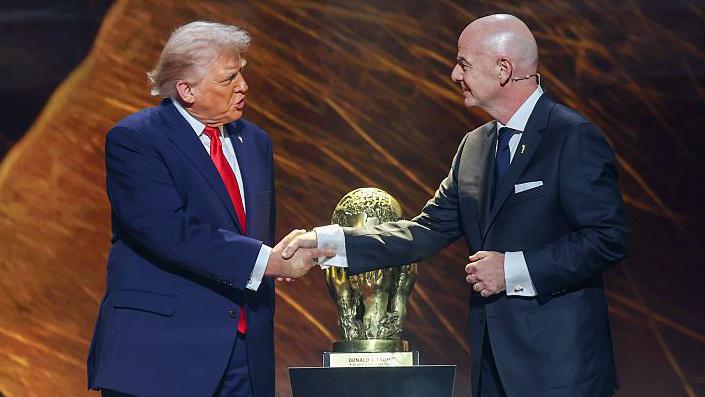
In the glittering world of international football, where the roar of crowds meets the weight of global politics, a new controversy has erupted at FIFA’s doorstep. On December 5, 2025, during the lavish draw for the 2026 FIFA World Cup at Washington’s Kennedy Center, President Gianni Infantino presented U.S. President Donald Trump with the inaugural FIFA Peace Prize. What was billed as a celebration of unity quickly spiraled into accusations of ethical misconduct, with human rights group FairSquare filing a formal complaint against Infantino on December 8. Alleging “repeated breaches” of FIFA’s political neutrality rules, the eight-page dossier demands an investigation into Infantino’s actions and the prize’s creation itself. As the 2026 World Cup—set to unfold across the United States, Canada, and Mexico from June 11 to July 19—looms large, this FIFA Infantino Trump peace prize scandal raises profound questions: Has the sport’s governing body sacrificed impartiality for political favor, or is this a visionary gesture in turbulent times? For football enthusiasts and ethics watchdogs alike, the stakes couldn’t be higher, blending the thrill of the beautiful game with the intrigue of international diplomacy.
The Ceremony That Sparked Outrage: A Golden Trophy Amid Global Tensions
Picture this: Under the opulent chandeliers of the Kennedy Center, Infantino and Trump stood shoulder-to-shoulder, flanked by leaders from the host nations. The event, attended by dignitaries and broadcast worldwide, marked the unveiling of the 2026 World Cup groups—a tournament poised to break records with 48 teams and 104 matches. But before the draw commenced, Infantino unveiled a surprise: the FIFA Peace Prize, a gleaming golden trophy, medal, and certificate honoring Trump’s “unwavering commitment to advancing peace and unity.”
Infantino’s speech was effusive. “This is what we want from a leader,” he declared, adding, “You can always count, Mr. President, on my support.” The moment capped a year of overt camaraderie, including Infantino’s attendance at Trump’s January 20, 2025, inauguration rally and a subsequent Instagram video where he echoed Trump’s slogan: “Together we will make not only America great again, but also the entire world.” Trump, beaming with a U.S. flag pin on his lapel, called it “one of the great honors of my life,” especially poignant after his October 2025 Nobel Peace Prize snub for brokering an Israel-Gaza ceasefire.
Yet, this spectacle—amid a U.S. political landscape still healing from the 2024 election—drew immediate backlash. Human Rights Watch had already questioned the prize’s “process and criteria” upon its November announcement. Now, FairSquare’s complaint has escalated the FIFA Infantino Trump peace prize saga into a full ethics probe, spotlighting how football’s apex body navigates power.
Unpacking the Allegations: Four Clear Breaches of FIFA’s Code of Ethics
At the heart of FairSquare’s grievance lies Article 15 of FIFA’s Code of Ethics, which mandates that officials “remain politically neutral… in dealings with government institutions.” Violations carry penalties up to a two-year ban from football activities. The complaint meticulously outlines four breaches, painting a picture of Infantino’s “openly flouting” of neutrality for personal or organizational gain.
First, the prize itself: FairSquare argues awarding such an honor to a sitting head of state inherently endorses a political figure, undermining FIFA’s apolitical stance. “The award of a prize of this nature to a sitting political leader is in and of itself a clear breach,” the letter states, questioning whether Infantino acted unilaterally without FIFA Council approval—a potential “egregious abuse of power.”
Second, Infantino’s October 9, 2025, Instagram post lobbying for Trump’s Nobel Peace Prize. Referencing Trump’s role in the Israel-Gaza truce, Infantino wrote: “President Donald J. Trump definitely deserves the Nobel Peace Prize for his decisive actions.” FairSquare deems this a “clear personal endorsement of President Trump’s intervention in a contentious political situation,” especially as the Nobel went to Venezuelan activist Maria Corina Machado.
Third, a November 2025 interview at the American Business Forum in Miami, where Infantino urged: “We should all support what [Trump] is doing [in the US] because I think it’s looking pretty good.” This, critics say, crosses into explicit policy backing.
Fourth, the January 20 Instagram video post-inauguration, where Infantino’s “Make America Great Again” remix signals alignment with Trump’s MAGA agenda. FairSquare’s programme director, Nicholas McGeehan, emphasized: “This complaint is about a lot more than Infantino’s support for President Donald Trump’s political agenda. More broadly, this is about how FIFA’s absurd governance structure has allowed Gianni Infantino to openly flout the organisation’s rules and act in ways that are both dangerous and directly contrary to the interests of the world’s most popular sport.”
FIFA has not confirmed receipt of the complaint, with its Ethics Committee—chaired by independent investigators—maintaining silence on potential cases. However, the body’s history of probes, from the 2015 corruption scandal to recent human rights lapses in Qatar 2022, suggests scrutiny is inevitable.
| Alleged Breaches in FIFA Infantino Trump Peace Prize Complaint | Date | Action by Infantino | Why It Violates Article 15 |
|---|---|---|---|
| Nobel Peace Prize Endorsement | Oct 9, 2025 | Instagram post praising Trump’s Israel-Gaza role | Personal endorsement of political intervention |
| Public Support Statement | Nov 2025 | Miami interview urging backing of Trump’s policies | Explicit call to support U.S. government actions |
| Inauguration Video | Jan 20, 2025 | Instagram echoing “Make America Great Again” slogan | Alignment with partisan political rhetoric |
| FIFA Peace Prize Award | Dec 5, 2025 | Presentation to sitting president without clear process | Inherent breach via honoring political leader |
Infantino’s Defense and FIFA’s Rocky History with Politics
Infantino, 55, has long courted controversy. Elected FIFA president in 2016 amid the Blatter-era scandals, he promised reform but faced criticism for centralizing power. His close ties to Trump—calling him a “close friend”—echo past alliances, like with Vladimir Putin during Russia 2018. Supporters argue such diplomacy secures hosting deals and funding; the 2026 tournament, FIFA’s crown jewel, could generate $11 billion in revenue, bolstering global development programs.
Yet, FairSquare contends Infantino oversteps, lacking authority to “unilaterally dictate the organisation’s mission, strategic direction, policies and values.” The prize’s opaque creation—announced in November without FIFA Council vetting—fuels claims of caprice. As McGeehan noted on social media, this isn’t isolated; it’s symptomatic of a “governance structure” enabling unchecked actions.
Public reaction has been swift and polarized. On platforms like X (formerly Twitter), users decry Infantino as a “Trump sycophant,” with posts from activists like @zazzybritches amplifying FairSquare’s call: “Gianni Infantino accused of breaking Fifa rules.” Others, including @TRTWorld, highlight the ethics violation’s broader implications for football’s integrity.
The Road Ahead: Implications for FIFA, the World Cup, and Global Football
As the Ethics Committee deliberates—potentially launching a probe within weeks—this FIFA Infantino Trump peace prize controversy could reshape football’s political boundaries. A finding against Infantino might lead to sanctions, eroding his grip on FIFA ahead of the 2027 election. For the 2026 World Cup, it risks overshadowing the on-pitch drama, from Messi’s potential swan song to emerging stars like Yamal.
Broader lessons emerge for FIFA multi-club ownership rules and neutrality in a polarized era. With tournaments in Saudi Arabia (2034) and beyond, maintaining impartiality isn’t just ethical—it’s essential for credibility. FairSquare’s push underscores a growing demand for accountability, ensuring football unites rather than divides.
In the end, this saga reminds us: Behind the goals and glory lies a delicate balance. Will FIFA red-card its president’s overtures, or double down on diplomacy? As kickoff approaches, the world watches—not just for the score, but for the soul of the game.
