FIFA President Infantino Faces Backlash Over Call to Reconsider Russia Football Ban
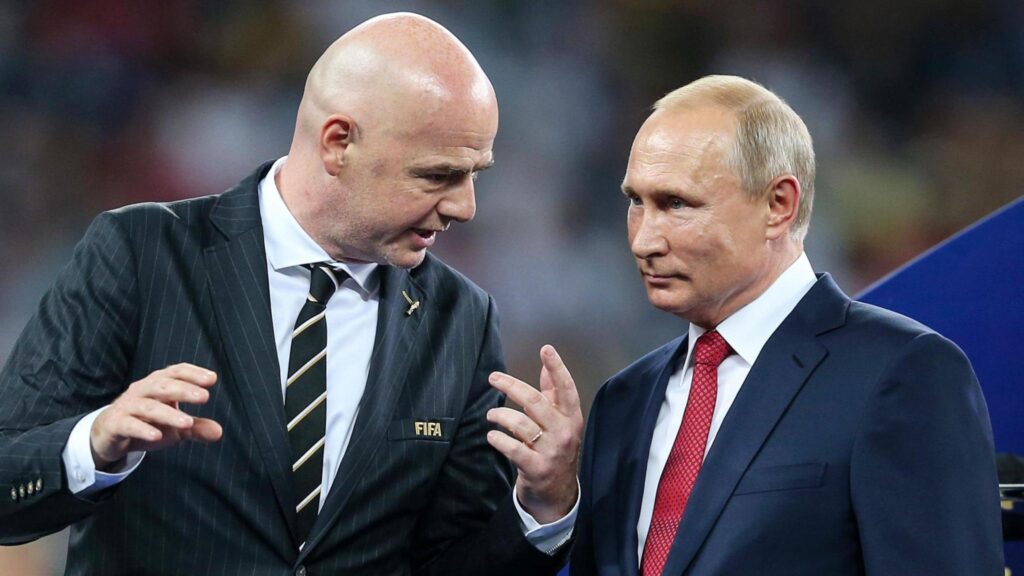
The intersection of sport and geopolitics often sparks intense debate, and few issues illustrate this better than the ongoing suspension of Russian teams from international football. In February 2026, FIFA President Gianni Infantino drew widespread criticism for suggesting that the four-year ban on Russia—imposed after the 2022 invasion of Ukraine—be reassessed. His comments have reignited discussions on whether sporting isolation effectively addresses conflict or merely deepens divisions.
Infantino’s Remarks and Rationale
Speaking recently, Infantino expressed concern that the blanket exclusion of Russian national teams and clubs has “not achieved anything” beyond fostering “more frustration and hatred.” He emphasized the potential benefits of inclusion, particularly for younger generations: “Having girls and boys from Russia being able to play football games in other parts of Europe would help.” The FIFA chief, who received Russia’s Order of Friendship medal from President Vladimir Putin following the successful hosting of the 2018 World Cup, argued for a nuanced approach amid persistent global tensions.
These statements come as Russia remains sidelined from key competitions. The country missed the 2022 World Cup, UEFA Euro 2024, and will not feature in the expanded 2026 World Cup co-hosted by the United States, Canada, and Mexico. While fully isolated from FIFA and UEFA events, Russia has continued limited international activity through friendlies against nations primarily outside Western alliances, without requiring governing body approval.
Ukraine’s Outraged Response
Ukraine’s Sports Minister Matvii Bidnyi wasted no time in condemning Infantino’s position. In a pointed social media statement, he labeled the comments “irresponsible—not to say infantile,” accusing them of detaching football from the harsh realities on the ground. Bidnyi highlighted the profound human toll: since Russia’s full-scale invasion began, more than 650 Ukrainian athletes and coaches have been killed, including over 100 footballers.
“War is a crime, not politics,” Bidnyi asserted. “It is Russia that politicizes sport and uses it to justify aggression.” He aligned with the Ukrainian Association of Football, warning against any return of Russian teams to international arenas. As long as the conflict persists, Bidnyi argued, Russian flags and symbols have no place in competitions valuing justice, integrity, and fair play.
This rebuke underscores Ukraine’s firm stance that sporting sanctions must remain until accountability is achieved, viewing any relaxation as a normalization of aggression.
Timeline of the Russia Football Suspension
To understand the context, consider the key milestones since the ban’s imposition:
| Date | Event | Impact |
|---|---|---|
| February 2022 | FIFA and UEFA suspend Russian teams and clubs following invasion | Immediate exclusion from all competitions |
| 2022 World Cup | Russia barred from qualifiers | Missed tournament in Qatar |
| UEFA Euro 2024 | Continued suspension | No participation in Germany |
| 2026 World Cup | Ban upheld; no qualifying involvement | Excluded from North American event |
| February 2026 | Infantino suggests reviewing ban for potential youth integration | Sparks international controversy |
This timeline reflects sustained enforcement by FIFA and UEFA, with no indications of imminent reversal despite Infantino’s personal views.
Parallels in Other Sports
The debate echoes challenges in other disciplines. Last year, the International Paralympic Committee (IPC) partially lifted restrictions on Russian and Belarusian athletes—Russia’s close ally in the conflict. Ukraine fiercely criticized the move, with its National Paralympic Committee decrying the allowance of flags “drenched in the blood of hundreds of thousands.”
In practice, however, Russian and Belarusian para-athletes will be absent from the 2026 Winter Paralympics in Milan and Cortina d’Ampezzo. Although the IPC oversees the Games, individual governing bodies for the six sports maintain their own bans. Three have upheld exclusions outright, while a late decision in ice hockey prevented timely qualification. This fragmented approach illustrates the complexities of enforcing uniform sanctions across global sport.
Broader Implications for Football and Beyond
Infantino’s intervention raises fundamental questions: Can sporting bans influence geopolitical outcomes, or do they risk alienating future generations without resolving root causes? Proponents of the suspension argue it upholds moral standards and solidarity with affected nations. Critics, including Infantino, contend that isolation breeds resentment and limits sport’s unifying power.
As the 2026 World Cup approaches, the football community watches closely. FIFA’s ultimate decision will not only shape Russia’s sporting future but also set precedents for handling conflicts in an increasingly polarized world. For now, the ban stands firm, a stark reminder that on-field rivalries remain overshadowed by off-field realities.
This episode reinforces football’s role as a global stage where politics and passion collide. Fans and stakeholders alike hope for resolutions that prioritize both competition and humanity.
Follow for real-time match analysis! 
Discover more from DeeplyticAI
Subscribe to get the latest posts sent to your email.