
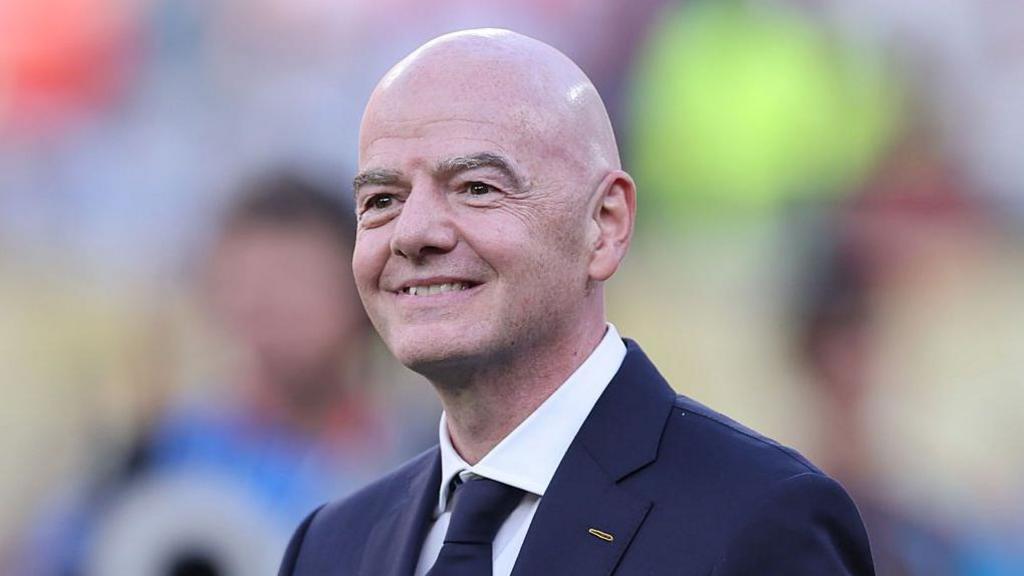
FIFA president Gianni Infantino has launched a striking counterattack against his detractors, telling critics to “meditate, pray or watch a football match” rather than “spreading hate and false rumours” about his leadership and the 2026 World Cup. In a 15-slide post on his personal Instagram account—subsequently reposted to FIFA’s eight million followers—Infantino directly addressed what he characterized as a campaign of negativity from media and commentators, while simultaneously downplaying several high-profile controversies that marred the tournament.
Infantino’s Defiant Message to Critics
“Seeds of Hate” vs. “The Greatest Event on Earth”
Writing in pointed language, Infantino directed his remarks at “those behind their pens and papers, behind their screens,” asserting that while critics were “busy planting seeds of hate,” FIFA was delivering the “greatest event on earth.” He described the 2026 World Cup as a celebration of “humanity at its best,” claiming the tournament featured “100% safety and security, only joy and happiness.”
The FIFA president further doubled down on the tournament’s safety record, insisting there were “zero incidents, zero violence, just joy, emotions, happiness, unity, and togetherness.” However, this characterization stands in stark contrast to several documented incidents that occurred during the competition.
Contradictions with On-the-Ground Reality
Despite Infantino’s claims of a trouble-free tournament, FIFA is currently investigating Argentina’s actions after players and backroom staff became involved in physical altercations with Spain’s squad following the World Cup final. Additionally, the governing body is examining allegations of racist abuse directed at American social media influencer IShowSpeed, while supporters were arrested at multiple matches, including following England’s semi-final against Argentina in Atlanta. The controversial presence of Immigration and Customs Enforcement (ICE) officials at World Cup stadiums also drew significant criticism.
The Iran Controversy and Visa Issues
A Disputed Narrative of Unity
Infantino specifically highlighted Iran’s participation as evidence of FIFA’s unifying mission, stating that the organization “worked tirelessly to unite two countries at war” and that Iran entered the United States “without incident or conflict.” This framing directly contradicts the account of Iran’s head coach Amir Ghalenoei, who described his team as the “most oppressed” at the World Cup.
The reality of Iran’s tournament experience was considerably more troubled than Infantino suggested. The team faced significant visa delays, had “integral” members of their backroom staff denied entry to the US, and saw their fan ticket allocations revoked. Furthermore, Iran was forced to relocate their training base from Tucson, Arizona, to Tijuana, Mexico, following numerous logistical issues. They also encountered restrictions on their movements while travelling between their training base and group matches in Los Angeles and Seattle.
Broader Travel Ban Impact
These difficulties were not unique to Iran. Fans from Haiti, Senegal, and Ivory Coast were similarly impacted by travel bans imposed by the Trump administration. Perhaps most notably, Somali referee Omar Artan was denied entry to the United States despite holding both a diplomatic passport and a single-entry US visa, with authorities citing his “association with suspected members of terror organisations.”
Infantino addressed these issues dismissively, writing: “You mentioned the few people denied visas and overlooked the millions who were approved, from all parts of the world. Because football unites the world, and it was impressively demonstrated this summer.”
The Balogun Controversy and Political Interference Allegations
An Unprecedented Decision
Infantino also addressed widespread criticism surrounding the standard of officiating and, more specifically, concerns about political interference after USA forward Folarin Balogun was made available for their last-16 tie. Balogun’s automatic one-match suspension was lifted by FIFA following the personal intervention of US President Donald Trump—a decision of extraordinary rarity. Of the 191 other red cards shown in men’s World Cup history, only one other player has escaped a suspension.
UEFA condemned the ruling in the strongest terms, stating it had “crossed a red line” and labelling it “unprecedented, incomprehensible, and unjustifiable.” The Norwegian Football Federation is also considering filing a formal complaint with FIFA’s ethics committee.
Infantino, however, dismissed the controversy by arguing that similar rulings are “routine and widely accepted in some of the biggest leagues worldwide,” adding: “It’s curious that the same countries employing these practices are the ones criticising.”
Meanwhile, the International Olympic Committee confirmed it will not investigate Infantino for possible breaches of political neutrality, stating that the complaint filed by human rights campaign group FairSquare falls outside the jurisdiction of its ethics commission.
A Call for “Love, Not Hate”
Infantino’s Closing Appeal
Concluding his lengthy post, Infantino urged his opponents to “show some love” and “respect” for a tournament where “people came together as families, as fans, as one.” His final message struck a deliberately emotional tone.
“To everyone who missed our beautiful game, the emotions, the celebrations, the laughter, the crying… sorry that you were so consumed by hate and criticism that you missed it all,” he wrote. “Our world needs love, not hate; tolerance, not division; celebration, not mourning.”
He added: “To those spending their time and energy hating us, please take a moment to reflect, meditate, pray or watch a football match and truly observe the faces, the eyes, the emotions. Because only our beautiful game can deliver such an extraordinary show.”
Whether this defiant response will silence FIFA’s critics or further inflame the ongoing debate about governance, transparency, and political neutrality in world football remains to be seen. What is certain, however, is that the controversies of the 2026 World Cup will continue to generate scrutiny long after the final whistle has blown.
