
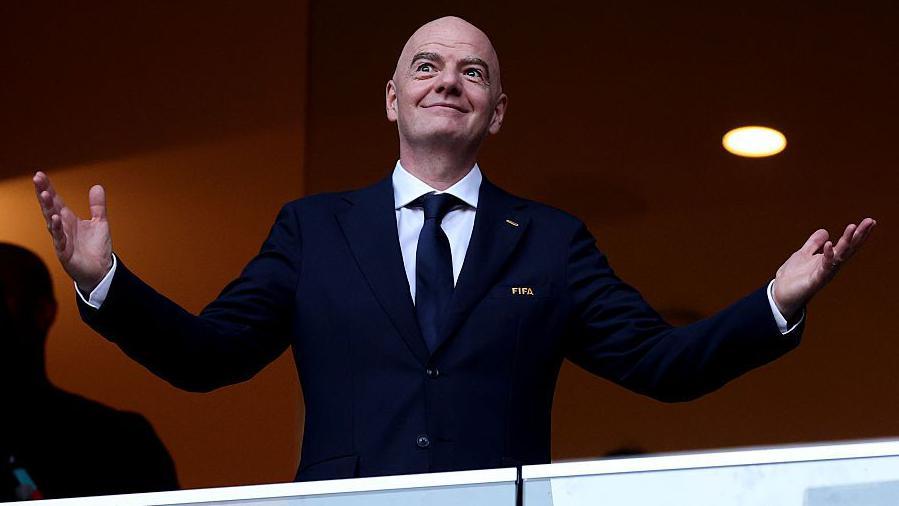
Following the conclusion of the 2026 FIFA World Cup, discussions regarding the future format of football’s premier tournament have reignited with unprecedented intensity. FIFA President Gianni Infantino has officially opened the door to a potential 64-team World Cup, arguing that the sport’s ultimate prize must be accessible to the “whole world.” While the proposal promises greater global inclusion, it also faces severe logistical hurdles and fierce opposition from major football confederations.
The Vision for a Truly Global Tournament
When asked by Swiss broadcaster Blue Sport about the possibility of further expansion, Infantino made his stance clear. “These are all issues that we will be examining after the World Cup,” he stated, emphasizing a philosophy of global inclusivity. According to the FIFA president, organizing a World Cup must extend far beyond traditional powerhouses in Europe and South America.
Infantino argues that every nation should be allowed to dream of participating on the global stage. He pointed to the rising standard of international football, noting that the quality of teams is improving rapidly across all continents. Consequently, he believes that denying smaller nations a chance to participate removes their primary incentive to keep improving their domestic football infrastructure.
The Case for Expansion: Empowering Smaller Nations
To justify the push for a 64-team World Cup, Infantino highlighted the perceived success of the current 48-team format, which was first approved by the FIFA Council in 2017. He cited the remarkable progression of African nations as definitive proof that expansion works.
“At the last World Cup, there were only five teams from Africa,” Infantino noted. “That just goes to show how important it is to include all teams—to give them this opportunity to participate.” By pointing to the fact that nine out of ten African teams advanced to the knockout stages in the recent tournament, FIFA leadership aims to demonstrate that broader participation directly correlates with competitive growth and global engagement.
Growing Backlash from Global Football Confederations
Despite Infantino’s optimistic vision, the proposal for a 64-team World Cup has encountered substantial resistance from the very confederations that govern the sport. Critics argue that further dilution will compromise the tournament’s prestige and competitive integrity.
Continental Leaders Voice Strong Opposition
UEFA President Aleksander Ceferin has been particularly vocal, dismissing the expansion as a “bad idea” for both the tournament itself and the grueling qualifying process. Similarly, Asian Football Confederation (AFC) President Sheikh Salman bin Ibrahim Al Khalifa warned that further expansion would inevitably bring “chaos” to the international calendar. Furthermore, Victor Montagliani, president of Concacaf, stated that the suggestion “doesn’t feel right,” expressing deep concerns that it would damage the broader football ecosystem by overloading an already congested schedule.
Logistical Nightmares and Hosting Challenges
Beyond political pushback, the practical realities of hosting a 64-team World Cup present monumental challenges. As the tournament grows, the burden on host nations increases exponentially.
The Reality of 128 Matches
The 2026 tournament already stretched across three vast countries. Looking ahead, the 2030 edition will feature matches in six different nations: Morocco, Portugal, and Spain, alongside Argentina, Paraguay, and Uruguay, who will host opening matches to celebrate the competition’s centenary.
Consequently, the prospect of the 2034 World Cup in Saudi Arabia hosting a 128-match tournament raises serious logistical questions. Infrastructure, transportation, and accommodation would need to be scaled to unprecedented levels, making the feasibility of such an event highly uncertain.
The Political and Financial Drivers Behind the Proposal
If the logistical and political hurdles are so significant, why does FIFA continue to explore this avenue? The answer lies in the intersection of revenue and voting power.
Revenue Distribution and Electoral Influence
A 64-team World Cup would allow nearly a third of FIFA’s 211 member associations to qualify for the finals. This massive increase in participation serves as a powerful vote-winner for Infantino, securing loyalty from developing football nations. Moreover, a larger tournament generates significantly more broadcasting and commercial revenue, which can then be distributed to member associations worldwide through programs like FIFA Forward.
Even outside traditional football strongholds, the idea has found some traction. Andrew Giuliani, executive director of the White House’s World Cup task force, recently suggested that the United States could consider bidding for the 2038 tournament, confidently asserting that the US infrastructure could “handle” a 64-team format.
Conclusion: A Distant Reality?
Ultimately, FIFA’s official position remains that it will discuss expansion ideas with stakeholders and is duty-bound to consider proposals from council members, such as the one put forward by Conmebol in April 2025. However, the FIFA Council will make the final decision, and there are currently no signs that a 64-team World Cup will be approved imminently. While the dream of universal inclusion is compelling, the sheer logistical weight and institutional resistance suggest that the 48-team format will remain the standard for the foreseeable future.
