
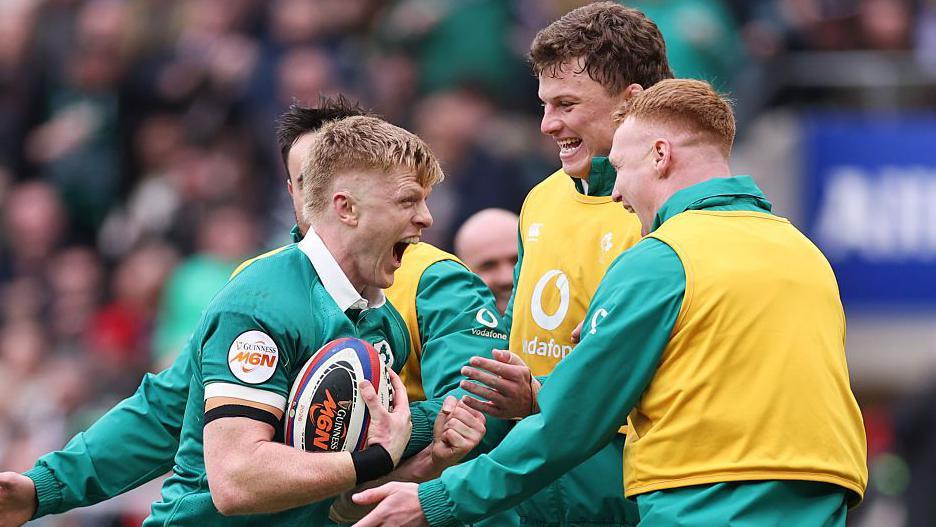
Saturday, 21 February 2026 will go down as one of the darkest days in recent English rugby history—and one of the finest in Ireland’s. Ireland delivered a statement performance for the ages to stun England and claim a record 42–21 Six Nations win at Twickenham. The 21-point margin of victory was devastating, and the manner in which it was achieved even more so. Ireland’s 42 points was the most they had scored against England in England; the 21-point winning margin was also Ireland’s biggest against England in England.
For Andy Farrell’s side, the result was nothing short of a rebirth. Not since Ireland’s win at the start of 2024—when they dismantled France in Marseille—had the side hit the heights they reached in London in this demolition job, bettering their previous biggest winning margin of 17 points in 2022. For Steve Borthwick’s England, it marked a second successive defeat in the 2026 Six Nations following a 31–20 loss to Scotland at Murrayfield, effectively ending their championship hopes.
A Blistering First Half Sets the Tone
Ireland’s gameplan was clinical from the very first whistle. The visitors built a commanding 22–0 lead midway through the first half with three tries in ten minutes from Jamison Gibson-Park, Robert Baloucoune, and Tommy O’Brien.
The opening try was a masterclass in opportunism. Ireland struck for the opening try in the 20th minute when Baloucoune and O’Brien combined to take play into the 22, and when McCarthy carried on and England infringed, Gibson-Park took a clever quick-tap penalty to slide over in the corner. England’s failure to reset quickly was punished ruthlessly—a theme that would define the afternoon.
The second try arrived in the 27th minute: O’Brien claiming a high ball, Stuart McCloskey making a stunning break past Lawrence, and Gibson-Park firing a long pass out to Baloucoune. England were also reduced to 14 players as Steward was sin-binned for cynically playing Gibson-Park before the scrum-half got his pass away.
Ireland’s third first-half try came when replacement Tommy O’Brien finished a sweeping counter-attack. Doris skilfully moved the ball on to Baloucoune on his opposite wing to dummy Freeman deftly, draw the last man, and put O’Brien away. O’Brien had entered the fray early after James Lowe suffered a calf injury, and his impact was immediate and devastating.
After earlier handling errors cost them promising opportunities, England reduced the deficit to 22–7 when Fraser Dingwall crossed just before the break. George Ford converted, offering the faintest flicker of hope heading into the second half.
Ireland Seal the Bonus Point and Pull Away
Any prospect of an English comeback evaporated within minutes of the restart. Caelan Doris cut through in midfield, and England’s scramble defence had to concede a penalty, with Henry Pollock—making his first senior start—going to the sin bin for cynical play.1 Ireland secured a bonus point early in the second half when Dan Sheehan squeezed over for their fourth try.
Ollie Lawrence struck under the posts in the 54th minute as England attempted to spark a comeback. Ford’s conversion briefly narrowed the gap to 29–14. However, two further penalties from Jack Crowley made that task even harder, and Jamie Osborne crossed in the 70th minute to put the contest beyond doubt. Crowley finished the match with 17 points from the boot.1
Replacement Sam Underhill added a late consolation for England, but by then many home fans had trudged away from the stadium. The scoreboard read 42–21—a record-breaking scoreline in this fixture on English soil.
Key Performers: Gibson-Park, Baloucoune, and Crowley Shine
Man of the match Gibson-Park was the heartbeat of everything Ireland did. The scrum-half ran the show in style, with Stuart McCloskey and Caelan Doris among those playing strong supporting roles. His quick-tap try set the tone, and his distribution and decision-making throughout kept England scrambling.
Robert Baloucoune was outstanding on the wing, continuing his excellent form from the Italy match. His acceleration, aerial prowess, and defensive work made him one of the most dangerous players on the pitch. In tandem with Tommy O’Brien, this might have been Ireland’s quickest-ever combination on the wings.
At fly-half, Jack Crowley silenced the ongoing number 10 debate—at least for now. Ireland’s record victory was testament to their precision and brilliantly executed gameplan. Crowley’s tactical kicking, goalkicking accuracy, and composure in steering his side around the park were essential to the dominant display.
England’s Dismal Day and a Soured Itoje Milestone
This was supposed to be a celebratory occasion for England. Captain Maro Itoje earned his 100th Test cap, and Henry Pollock was handed his first Test start at number eight. Instead, the occasion was completely overshadowed by a disjointed and undisciplined performance. England’s discipline was shoddy, their lineout wayward, and their defence porous.
England’s first Twickenham defeat since a November 2024 loss to world champions South Africa followed last week’s 31–20 reverse away to Scotland, ending their 12-game winning run at home. The hosts had both Freddie Steward and Pollock sin-binned during the match, and head coach Steve Borthwick now faces serious questions about his side’s direction.
What This Means for the 2026 Six Nations Title Race
England’s second defeat in a row effectively ends their title hopes, while Ireland will look for a favour from Scotland or England when they meet leaders France in rounds four and five. After the Round 3 results, Scotland sit first, France second, and Ireland third in the 2026 Six Nations table.
Ireland’s path to the title remains narrow. The visitors are still in the running for the championship but may rue not picking up a late bonus point in last week’s win over Italy. Ireland could still claim the Triple Crown, which they won last year.
Looking ahead, Ireland host Wales on Friday, 6 March, while England travel to Rome on Saturday, 7 March. For Ireland, the Wales fixture represents a chance to build momentum before a potential championship-deciding final round. For England, the trip to Italy is now about salvaging pride in what has rapidly become a Six Nations to forget.
The Bigger Picture: Ireland’s Renaissance Under Farrell
This was Ireland’s fifth win from their last six championship meetings against England.1 More significantly, it was a performance that recalled the cohesion, speed, and ruthlessness of the team that claimed back-to-back Six Nations titles in 2023 and 2024.
Andy Farrell’s team, who had been under considerable pressure, scored five tries as they completely outplayed the hosts. The multi-phase attacking game was back, the defence was resolute, and the off-the-cuff finishing on the wings was lethal. In front of at least 20,000 supporters clad in green, this was a five-try, five-star win.
Whether Ireland can sustain this form over the remaining rounds—and whether results elsewhere fall in their favour—remains to be seen. But after Saturday’s historic demolition job at Twickenham, nobody is writing off Andy Farrell’s squad any longer.

