
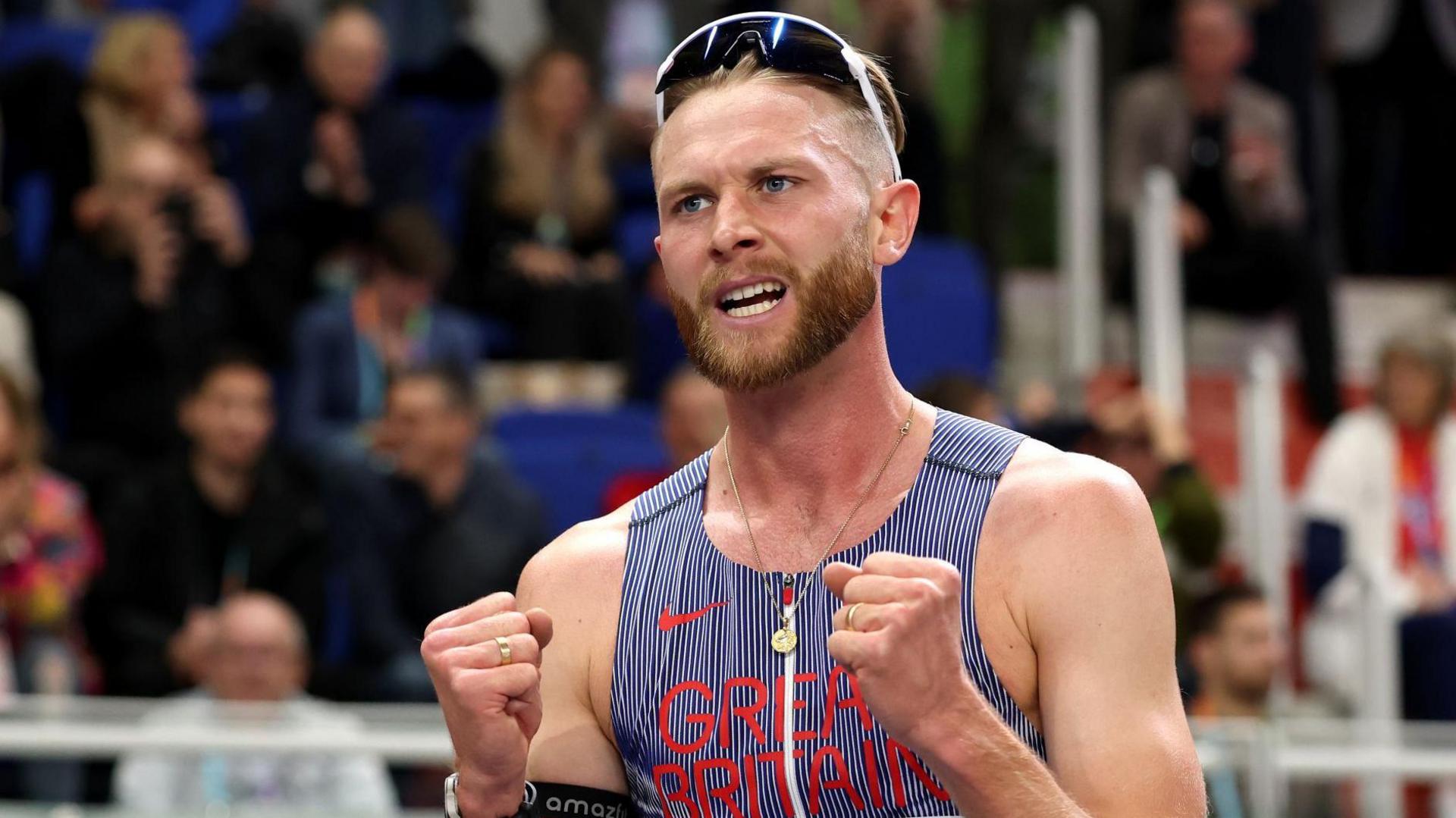
Josh Kerr produced a commanding performance to win the men’s 3,000m gold at the World Athletics Indoor Championships in Toruń, Poland, on March 22, 2026. The 28-year-old Scot clocked 7:35.56 to defend the title he first won on home soil in Glasgow two years earlier, marking Britain’s first medal of the competition.
Kerr’s victory was especially poignant following a devastating injury setback. In September 2025, he tore his calf during the men’s 1500m final at the World Athletics Championships in Tokyo, forcing him to hobble across the line and ending his title defence. The grade-two tear left him on crutches, unable even to walk to breakfast in the early recovery stages.
Six months later, Kerr has returned to the top of global podiums. He described the triumph as a “family win,” giving significant credit to his mother—who also serves as his physiotherapist—for guiding his rehabilitation.
“From where we were in Tokyo to right now, having another world gold medal, that’s all down to coaching, it’s all down to my physio and my mum,” Kerr told BBC Sport. “That’s a family win right there.”
Race Breakdown: Patience and Power
The 3,000m final brought together the complete set of Olympic 1500m medallists from Paris 2024, including Olympic champion Cole Hocker (USA), bronze medallist Yared Nuguse (USA), and Kerr himself. Ethiopia’s Addisu Yihune set the early pace, with the medal contenders tracking closely.
Kerr remained patient through the middle stages, gradually advancing his position. He hit the front at the bell and unleashed a powerful final lap kick. Hocker attempted to close but had no answer, taking silver, while Frenchman Yann Schrub claimed bronze.
Kerr admitted the race was far from perfect. “I think I created the problems myself tonight,” he said. “For people watching, that is not how you win a gold medal! I got in my own head about trying to not waste energy and there were some moves in there that made me have to show my hand a little bit.”
Still, he trusted his fitness: “I was just trying to relax in the chaos and trust that I’m fitter and better than the other guys.”
From Crutches to Global Podium
The calf injury originated from a freak overstretch at the end of his Tokyo semi-final. Kerr has since acknowledged that finishing the race likely worsened the damage, yet his recovery timeline proved faster than expected.
His mother’s hands-on physiotherapy played a central role. She was in the stands in Toruń to witness the payoff of their shared hard work. Kerr’s self-belief never wavered—he targeted a fifth global podium in five years—and he delivered.
Dina Asher-Smith Seventh in 60m Final
Britain’s Dina Asher-Smith placed seventh in the women’s 60m final in 7.07 seconds. She had equalled her British record of 7.03 in the heats but could not replicate that form in the medal race.
The 30-year-old, a former world 200m champion, is working with new coach Michael Ford in Texas after parting ways with Edrick Floreal mid-2025. “It wasn’t the most fabulous final,” she told BBC Sport. “I’m a bit disappointed but overall happy with my indoor season and how things are going with my new coach.”
Italy’s Zaynab Dosso took gold in 7.00 seconds, ahead of American Jacious Sears and St Lucia’s Olympic 100m champion Julien Alfred.
Armand Duplantis Equals Indoor Pole Vault Record
Sweden’s Armand Duplantis claimed his fourth world indoor pole vault gold—and ninth global title overall—with a championship-record clearance of 6.25m on first attempt. Greek Emmanouil Karalis took silver.
Duplantis elected not to chase another world record, content with victory.
Kerr’s Legacy Continues to Grow
Kerr’s journey from Tokyo crutches to Toruń gold underscores his mental toughness and technical quality. At 28, he remains one of middle-distance running’s most compelling figures.
Britain’s first medal of the championships sets an optimistic tone for the rest of the meet. Kerr’s victory reminds fans why he is among the sport’s most watchable athletes—capable of delivering when the stakes are highest.

