Labuschagne’s Form Hits Record Low but Australia Hint at Future
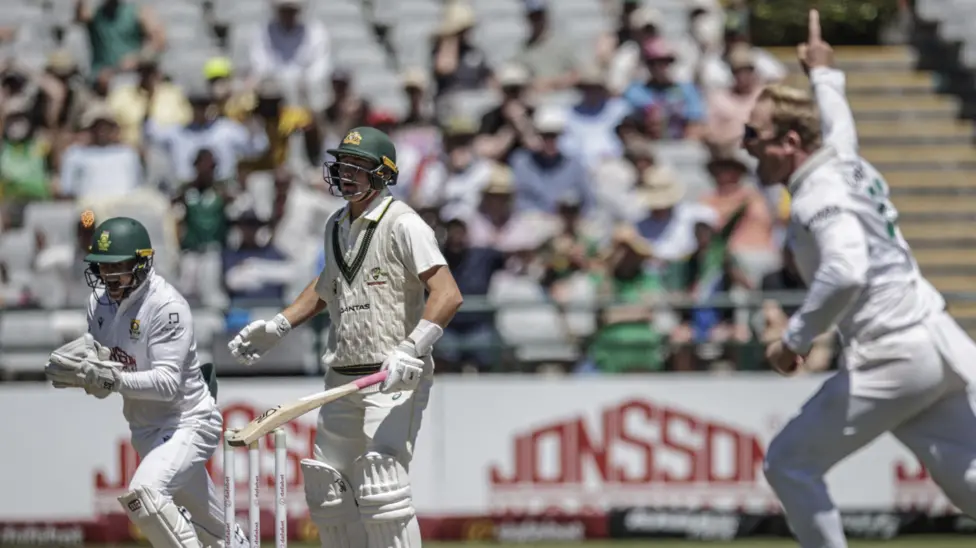
Marnus Labuschagne’s long struggle with the bat reached a painful new low on day two of the series-deciding third Test against South Africa in Cape Town. The 32-year-old lasted just five deliveries and was dismissed for a duck, extending his century drought to a record 48 consecutive Test innings for an Australian top-order batter. While Labuschagne’s form continues to raise serious questions about his place in the side, a group of less experienced teammates stepped up impressively, giving Australia a glimpse of what their batting lineup could look like in the years ahead.
A Painful Dismissal Extends the Drought
Australia began their reply to South Africa’s first-innings total of 329 with cautious optimism. Travis Head and Matt Renshaw put on a solid 58-run opening stand before Head chopped on to spinner Simon Harmer for 41. That brought Labuschagne to the crease in a moment that felt like a last-chance opportunity. With Steve Smith ruled out of the match through a neck injury, the Queenslander was expected to anchor the innings at number three.
Instead, Labuschagne looked tentative from the start. He played back to a full delivery from Harmer, edged to first slip, and walked off without scoring. The dismissal completed 48 successive Test innings without a century, breaking the previous mark for an Australian top-four batter. Former fast bowler Jason Gillespie called the record one that “will never be broken,” noting that future selectors are unlikely to show the same patience.
Labuschagne’s last Test hundred came at Old Trafford during the 2023 Ashes. Since then he has averaged just 24.77. In this series alone he had managed starts of 37, 37, 14 and 39 before the Cape Town failure. The pattern has become familiar: solid beginnings that rarely turn into substantial scores. Critics, including Ricky Ponting earlier in the year, have pointed to technical issues, particularly against the short ball and when forced onto the back foot. Simon Katich suggested the prolonged pressure from selectors has only added to the mental load.
New Guard Stands Tall in Cape Town
Yet the story of the day was not solely about Labuschagne’s struggles. After the early double blow left Australia at 58 for 2, Matt Renshaw, Cameron Green and Josh Inglis produced the kind of composed batting that has often been missing in recent series. Renshaw, who has waited patiently for consistent opportunities, scored a patient 74. The left-hander had already made a career-best 190 in the first Test in Durban and now looks increasingly secure in the side.
Green, long regarded as Australia’s golden all-rounder, finally played with the authority many have waited to see. His 65 featured clean striking and better decision-making than in previous attempts at number four. Most impressive of all was Josh Inglis. The wicketkeeper-batter had limited red-ball preparation after a broken finger and had not faced a cricket ball in the longer format since March. Coming in with the score at 185 for 4 after Marco Jansen removed both Renshaw and Green either side of tea, Inglis responded with an unbeaten 85. Together with Alex Carey, who finished 51 not out, the pair added an unbroken 145 runs that carried Australia to 330 for 4 at stumps, a slender one-run lead.
The performance of these three players offered a clear hint of Australia’s future. Renshaw has long been viewed as a potential long-term opener. Green continues to develop as a middle-order option and all-rounder. Inglis, despite limited experience at number three or four, showed the temperament required at the highest level. Their collective contribution transformed a potentially difficult day into one of genuine promise for the tourists.
What This Means for Selection and the Series
Australia now sit in a strong position to push for a series victory. Mitchell Starc’s six-wicket haul on the opening day had restricted South Africa to 329, and the batting response on day two put the hosts under pressure heading into the second half of the match. A first-innings lead, even a small one, would give the visitors control in a contest that remains tightly balanced.
For Labuschagne the picture is far less clear. He may still get a second innings in this Test if Australia’s lead does not grow large enough to force a declaration or if South Africa recover strongly. Even then, many observers believe his place is under severe threat ahead of the home series against New Zealand that begins in December. Selectors have shown remarkable loyalty, retaining him for the South Africa tour despite an average under 25 across his last 40-plus innings. That patience appears to be running out.
The broader context is one of transition. Smith will return for future matches, which would likely push Green and Inglis into different positions. Australia’s batting order has relied heavily on a core group for several years. Days like this one in Cape Town demonstrate that younger or less established players can deliver under pressure when given the chance.
Looking Ahead: Form, Faith and the Road Forward
Labuschagne’s career has already featured remarkable peaks. He once averaged over 60 across his first 30 Tests and briefly sat atop the ICC Test batting rankings. Those achievements still carry weight. Yet cricket is a results-driven sport, and prolonged periods of modest returns eventually force difficult decisions. The record century drought and the manner of the Cape Town dismissal have made those decisions harder to delay.
At the same time, the performances of Renshaw, Green and Inglis provide genuine encouragement. Australia’s ability to find contributors beyond their established stars will determine how competitive they remain in the World Test Championship cycle and in future Ashes contests. The Cape Town Test may ultimately be remembered less for Labuschagne’s latest failure and more for the way a new group of players answered the challenge when it mattered most.
As the match moves into its middle days, Australia hold a narrow advantage. South Africa will look to fight back with both bat and ball, while Labuschagne’s supporters will hope for one more opportunity to reverse the narrative. Whatever happens next, the events of day two have made one point clear: while one player’s form has hit a record low, Australia’s batting future already shows promising signs of strength.
Follow for real-time match analysis!🚀
Discover more from DeeplyticAI
Subscribe to get the latest posts sent to your email.