
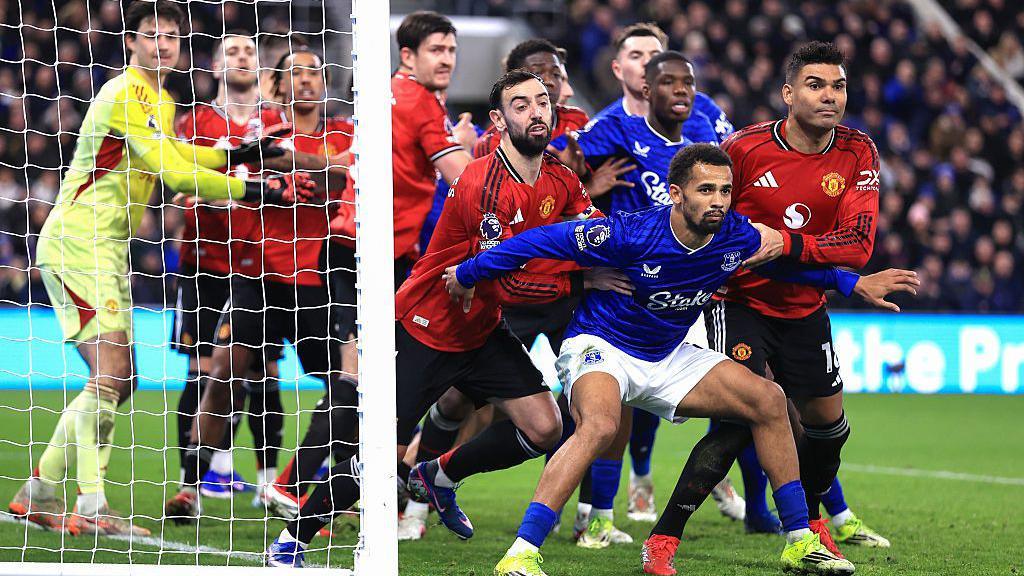
Premier League corner chaos has become one of the most discussed topics in English football during the 2025-26 season. Holding, wrestling, and deliberate blocking now dominate many dead-ball situations, creating crowded six-yard boxes that often resemble rugby scrums rather than football contests. While this physical approach has contributed to a rise in set-piece goals, it has also sparked widespread frustration among managers, referees, and supporters. For online readers passionate about Premier League set-piece tactics and potential law changes, the issue raises important questions about fairness, enjoyment, and the future direction of the game.
Moreover, the problem extends beyond isolated incidents. Former Premier League assistant referee Darren Cann described the situation as an “epidemic,” noting that up to 16 players can pack into the six-yard box during corners. This congestion makes policing extremely difficult for referee teams. Cann emphasised that “something needs to be done,” highlighting how defenders grapple with attackers and vice versa, often before the ball is even in play. Transitioning from these on-pitch battles, recent high-profile matches have brought the debate into sharp focus.
Recent Examples and Managerial Frustration
In Everton’s 3-2 victory over Manchester United, several Toffees players stood on goalkeeper Senne Lammens, while Leny Yoro was pushed into the net and Harry Maguire became involved. Everton manager David Moyes criticised referees for not intervening more firmly, stating it feels as though officials “really don’t want to get involved.” He described the lack of action as “really poor.” Similarly, after Chelsea’s 2-1 defeat to Arsenal, manager Liam Rosenior announced he was taking personal control of set-piece defending, having conceded twice from corners. Arsenal have been praised—and sometimes criticised—for perfecting these “dark arts” with stylish blocking and holding.
Furthermore, Liverpool boss Arne Slot expressed broader concerns about the spectacle. “Most of the games I see in the Premier League are not for me a joy to watch,” he said recently. “My football heart doesn’t like it.” Slot believes fouls that might be penalised elsewhere often go unpunished in England, allowing the tactic to thrive. This Premier League corner chaos is not just aesthetic; it reflects a strategic shift where set pieces have become decisive.
Set-Piece Goal Statistics Across Top European Leagues (2025-26 Season)
| League | Set-Piece Goals Percentage (excl. penalties) | Notable Trend |
|---|---|---|
| Premier League | 27% | Highest in Europe; Arsenal lead domestically |
| Serie A | 24% | Strong but below Premier League |
| Bundesliga | 22% | Balanced attacking styles |
| La Liga | 19% | Lower reliance on dead balls |
| Ligue 1 | 17% | Least set-piece dependent |
These figures demonstrate the Premier League’s unique emphasis on dead-ball situations, with Arsenal, Newcastle, and Manchester United among the most prolific. Seven penalties have already been awarded this season for holding at set pieces, four following VAR intervention, yet many incidents still go unpunished.
Referee Challenges and Existing Protocols
Professional Game Match Officials (PGMOL) provide referees with detailed dossiers on each team’s set-piece tactics before matches. Despite this preparation, the Premier League’s high threshold for fouls means much of the grappling is tolerated. Fans often express irritation when corners are retaken due to early infringements, but Cann points out that grappling frequently starts before the kick is taken. Once the ball is not in play, awarding a foul becomes impossible under current laws.
Additionally, social media amplifies the issue, with clips of unchecked holding contrasting sharply with VAR’s microscopic offside calls. This perception damages trust in officiating and the overall product. PGMOL argues that media focus intensifies only during high-profile cases, yet the volume of fan complaints suggests a deeper problem.
Proposed Solutions and IFAB’s Recent Decisions
Several practical ideas have emerged to address Premier League corner chaos. Alan Shearer, working alongside Cann on Match of the Day analysis, suggested a simple law change: once the referee blows the whistle to restart play, any subsequent grappling or blocking could be penalised immediately, even before the ball is kicked. Cann supports this and offers his own proposal—requiring attackers to start outside the six-yard box. This adjustment would reduce congestion, give goalkeepers more space, and ease the referee’s burden.
However, football’s lawmakers have not yet provided a direct fix. The International Football Association Board (IFAB) met in Wales on February 28, 2026, to discuss law changes for next season. While they approved wider VAR scope—including optional checks on corner awards and second yellow cards—plus new time-wasting measures like five-second countdowns for throws and goal kicks, grappling at set pieces was not specifically addressed. Scottish FA chief executive Ian Maxwell confirmed it was not a focus of discussions, noting that behavioural shifts occur gradually across a season. The Premier League is also expected to opt out of expanded VAR corner reviews.
Nevertheless, these developments show lawmakers are actively seeking ways to improve match flow and reduce disruption. Whether a dedicated rule change for set-piece behaviour will follow remains uncertain, but pressure from managers, pundits, and fans continues to grow.
Broader Impact on the Game and Potential Paths Forward
Set pieces have always been part of football’s tactical fabric, yet the current intensity risks turning corners into a battle of strength rather than skill. Teams invest heavily in specialist coaches and routines because the rewards are clear: the Premier League leads Europe in set-piece goals. Yet when tactics cross into excessive physicality, the spectacle suffers. Slot’s comments resonate with many who long for more fluid, open football.
Importantly, players and coaches continually seek edges within the rules. This evolution is natural, but when it verges on the farcical, intervention becomes necessary. Referees could adopt a stricter stance immediately, as former official Mark Halsey recently urged PGMOL to take a “no-nonsense” approach. Alternatively, IFAB could trial Cann or Shearer’s proposals in lower leagues or cup competitions before wider implementation.
For supporters and analysts following the Premier League corner chaos, the coming months will be telling. With 10 games left for most teams, set pieces will likely decide key matches. If grappling persists unchecked, fan disillusionment may grow. Conversely, clearer enforcement or law tweaks could restore balance, ensuring dead-ball situations enhance rather than overshadow the beautiful game.
Ultimately, the responsibility lies with multiple stakeholders. Referees must apply existing laws more consistently, while lawmakers consider targeted adjustments. Players and coaches, meanwhile, should reflect on whether winning at all costs justifies compromising the sport’s appeal. The Premier League remains the world’s most watched league precisely because of its intensity and drama—yet preserving that excitement requires addressing the very tactics that sometimes threaten to undermine it. As the season reaches its climax, solutions cannot come soon enough to keep corners thrilling rather than tiresome.
The ongoing debate serves as a reminder that football evolves constantly. Whether through referee education, cultural shifts within clubs, or formal law changes, the goal remains the same: protecting the integrity and enjoyment of the game for everyone involved. With IFAB’s recent focus on match flow, there is cautious optimism that set-piece chaos will eventually receive the attention it deserves.

