
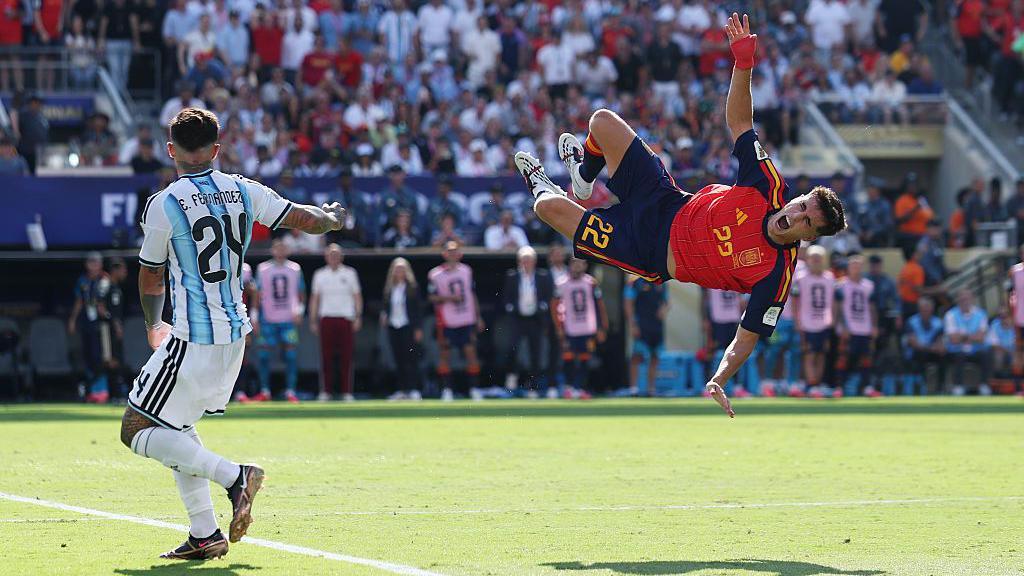
Describing a sporting result as a “victory for football” might sometimes feel like a trite cliché. However, few neutral observers would disagree with that assessment following Spain’s magnificent triumph in the 2026 World Cup final. When Ferran Torres slammed home the decisive extra-time winner, and captain Rodri lifted the coveted trophy high in New Jersey, it was difficult to imagine many sympathizing with the defeated Argentines.
Spain triumphed in a grueling battle of endurance, securing their second men’s World Cup title and cementing their status as the preeminent force in global football. On every conceivable metric—and, some would argue, on moral grounds as well—this was the right result.
Tactical Dominance: A Masterclass in New Jersey
From the opening whistle, Spain dictated the tempo of the 2026 World Cup final. The Iberian nation controlled a staggering 65% of possession, registering an expected goals (xG) tally of 1.94 and unleashing 20 shots on goal, with 11 forcing saves.
At the other end of the pitch, goalkeeper Unai Simon was nothing short of impenetrable. He secured his seventh clean sheet in eight matches during the tournament, rightfully earning the Golden Glove award for the competition’s best goalkeeper. Remarkably, Spain conceded just a single goal throughout the entire 2026 World Cup, marking the fewest goals allowed by any winning team in the tournament’s history.
“There is no doubt that the right team won,” former England captain Alan Shearer noted in his post-match analysis. “From start to finish, Spain controlled possession. They were the ones looking to play football, create chances, and get in behind. This is a result for football because of the way that they have played. Spain deserve it.”
A Historic Era of Spanish Supremacy
Even in the hard-to-quantify realm of international football, Spain’s current dominance is undeniable. They now hold the men’s World Cup, Olympic gold, the European Championship, and the Women’s World Cup titles simultaneously. Furthermore, the men’s team has extended their unbeaten run to 38 matches across all competitions, establishing the longest such streak by any European team in history.
Interestingly, Spain stumbled out of the gates in this tournament with a 0-0 draw against Cape Verde. This mirrors their 2010 campaign, where they also failed to win their opening match after a 1-0 loss to Switzerland, yet still went on to lift the trophy.
The technical superiority of the Spanish squad was further highlighted by their passing accuracy. There have only been three instances on record of a player completing 100 or more passes in a World Cup final. Astoundingly, two of those were Spain players on Sunday: Rodri with 101 passes, and teenage sensation Pau Cubarsi with an incredible 121.
Lamine Yamal Makes History at 19
For many in the Spanish squad, this victory is merely the beginning of a golden era. Nineteen-year-old Pau Cubarsi was named the Young Player of the Tournament, but it is his Barcelona teammate, Lamine Yamal, who continues to shatter expectations.
At 19 years and six days old, Yamal became the third-youngest player ever to feature in a World Cup final, trailing only footballing legends Pelé (1958) and Giuseppe Bergomi (1982). By lifting the trophy, he also became the third-youngest World Cup winner in history, solidifying his reputation as a generational talent with his best years still firmly ahead of him.
Argentina’s Frustration Boils Over in Defeat
Argentina is frequently painted as the pantomime villain of international football, and their performance in the first half of the final did little to dispel that notion. Much like their semi-final encounter against England, the defending champions appeared more interested in disrupting the flow of the game than playing it.
Leandro Paredes acted as the chief spoiler, with Enzo Fernández serving as his deputy. Although four Argentine players were booked, many observers felt this only reinforced the theory that the team received lenient treatment from match officials throughout the tournament. Ultimately, Argentina managed a mere 464 passes compared to Spain’s 852.
Despite the tactical stifling, Argentina’s goalkeeper Emiliano Martínez was forced to make 11 saves—the most by any goalkeeper on record in a World Cup final. Conversely, the defending champions made history for the wrong reasons, becoming the first team in World Cup history to fail to register a single shot during the 90 minutes of regulation time in a final. Their first attempt did not arrive until Lionel Messi’s effort in the 117th minute.
Disciplinary Breakdown and Post-Match Controversy
The match’s integrity was further compromised by Argentina’s disciplinary collapse. Enzo Fernández was initially shown a yellow card for dissent before receiving a second, resulting in a red card for a spectacularly late challenge that sent Pau Cubarsi somersaulting.
After the final whistle, the frustration boiled over into unsightly scraps. Paredes was involved in altercations with Rodri, Gavi, and Borja Iglesias, while teammate Nahuel Molina was seen throwing a punch at a passing Spanish player.
“Embarrassing, seeing that sort of stuff after the game has been played,” BBC pundit Wayne Rooney stated. “Someone has been crowned World Cup champions. It is not good enough.” Former England goalkeeper Joe Hart echoed this sentiment, labeling the conduct as “disgusting behaviour” and noting that after 120 minutes of being wound up, the Spanish players’ reactions were entirely understandable.
Argentina manager Lionel Scaloni, speaking through floods of tears at the post-match press conference, could only concede defeat. “Even though they were out-playing us until the 85th minute, I would love to know what would have happened had we still had 11 men on the pitch,” Scaloni admitted. “They deserved the victory, that is the reality.”
Conclusion
Ultimately, Argentina can have absolutely no complaints about the outcome of the 2026 World Cup final. While they managed to drag the match into extra time, continuing a trend of five of the past six finals going beyond 90 minutes, it could not mask their overall inferiority on the pitch. Spain’s victory was a masterclass in possession, patience, and clinical finishing, ensuring that the 2026 World Cup will be remembered as a true triumph for the beautiful game.
