
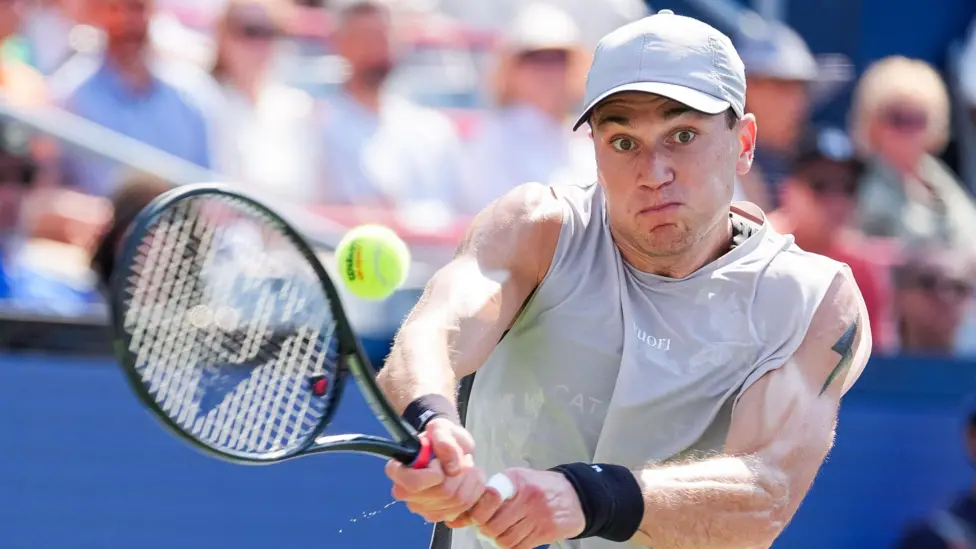
Jack Draper’s long-awaited return to competitive tennis ended in heartbreak and visible distress. The British player broke down in tears during a first-round defeat at the Canadian Open in Montreal, raising fresh concerns about the persistent arm injury that has disrupted his career. In his first match since June, the 24-year-old lost 6-3, 2-6, 6-2 to France’s Terence Atmane after showing flashes of his best form before the physical toll became overwhelming.
A Difficult Return After Months of Setbacks
Draper received a main-draw wildcard for the ATP Masters 1000 event following an extended absence. A bone-bruising injury in his left arm, first sustained around the time of the 2025 US Open, has repeatedly interrupted his progress. The problem forced him to withdraw from Wimbledon earlier this summer and also caused a late pull-out from the Washington Open. His world ranking has dropped sharply from a career-high of No. 4 to as low as the 140s and beyond during the prolonged recovery period.
The injury is described as complex and difficult to manage. High-velocity serving and groundstrokes place significant stress on the affected area, and recovery has required careful management rather than a simple surgical fix. Draper has spoken openly about the mental challenges of repeated setbacks, noting that the condition is extremely complicated and that his team continues to work diligently on solutions.
Match Overview: Promise Followed by Collapse
Against Atmane, ranked around No. 46, Draper began tentatively and dropped the opening set 6-3. He then produced a strong response in the second set, winning it 6-2 and looking closer to the player who once reached the US Open semi-finals and claimed the Indian Wells title. His movement improved and winners flowed more freely.
The third set, however, told a different story. Draper’s serve speed dropped noticeably and power drained from his shots. He surrendered the opening game after leading 40-15 and soon found himself broken again. Trailing 4-1, he sat down at the change of ends and was overcome with emotion, wiping tears from his eyes in a scene that left commentators and viewers deeply concerned.
Former British player Annabel Croft, commentating on Sky Sports, described the moment as “pretty emotional” and “very, very upsetting to see.” Another former British No. 1, Jo Durie, called it “so hard to watch,” adding that Draper had tried so hard to regain full fitness only to face further frustration.
Despite the distress, Draper continued playing. He created opportunities to break back but could not convert them. Atmane closed out the match and advanced to face Karen Khachanov in the second round. At the net, the Frenchman offered words of support, telling Draper he hoped everything would be all right.
Broader Context of Injury Struggles
This defeat marked only Draper’s sixth tournament of the season and highlighted the ongoing physical and emotional burden. The bone bruising has limited his ability to build consistent match practice and ranking points. Coaching support from Andy Murray has provided guidance during the recovery process, yet the body has not always cooperated with the timeline.
Draper holds a wildcard for the Cincinnati Open, which begins next week. His participation now appears uncertain. Further ahead lies the US Open, due to start later in August. Without a protected ranking or sufficient points, he would likely require another wildcard to compete in New York. The Montreal scenes have cast doubt over both events.
The Mental and Physical Toll on Elite Athletes
Scenes of a top player breaking down mid-match underscore the pressure elite tennis places on both body and mind. Chronic injuries that resist straightforward treatment create cycles of hope and disappointment. Players invest months in rehabilitation only to face renewed pain once competitive intensity returns. Draper’s openness about the complexity of his condition has helped illuminate these challenges for fans and fellow athletes.
British tennis continues to watch his progress closely. While younger players and other contenders advance, Draper’s talent remains clear whenever he is able to compete freely. His second-set performance against Atmane served as a reminder of the level he can still reach. The third-set collapse, however, showed how quickly that level can be undermined by physical limitations.
Looking Ahead with Caution
Draper’s immediate focus will centre on recovery and assessment. Medical evaluation after the Montreal match will determine whether further rest is required or whether adjusted training can support another attempt in Cincinnati. The tennis calendar offers limited windows for comebacks, and the North American hard-court swing is particularly demanding.
For online readers following British tennis, injury recovery stories, or the human side of professional sport, Draper’s experience offers a sobering yet compelling narrative. It highlights resilience in the face of repeated obstacles and the emotional reality that accompanies high-stakes competition. Supporters will hope the tears in Montreal mark a difficult chapter rather than a prolonged setback, and that the talented left-hander can eventually return to the form that once placed him among the world’s top players.
The Canadian Open exit was never going to be easy after such a long absence. Yet the visible struggle made it especially difficult to witness. Jack Draper has shown determination throughout his injury battles. The coming weeks will reveal whether that determination can overcome the physical barriers still standing in his way.
