The Rodri Dilemma: How Manchester City and Enzo Maresca Navigate Their Biggest Transfer Decision
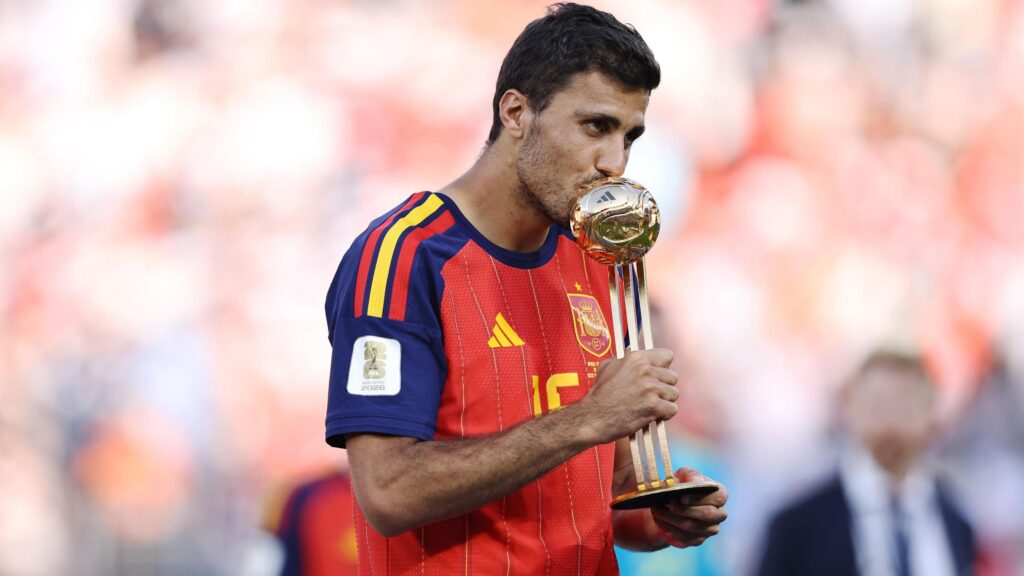
Manchester City find themselves in a period of significant transition. Replacing a manager after a decade of unprecedented success is no simple task, particularly when the squad itself appears to be undergoing a comprehensive overhaul. Four starters from the Treble-winning side of 2022-23—Manuel Akanji, Nathan Ake, Bernardo Silva, and John Stones—have departed this summer, while the club has brought in £116 million signing Elliot Anderson and promising 17-year-old Jeremy Monga. Yet the most pressing question facing new head coach Enzo Maresca revolves around one man: Rodri.
Rodri’s Situation: Surgery, Contract Uncertainty, and Real Madrid Interest
Fresh from captaining Spain to World Cup glory and earning the Golden Ball as the tournament’s best player, the 30-year-old midfielder is set to undergo back surgery on Monday. With just one year remaining on his contract, speculation about Rodri’s future has intensified considerably. Reports suggest Real Madrid are “operating on the basis” of the Ballon d’Or winner joining them, placing City in an unenviable position.
However, Maresca was unequivocal in his first press conference. “I think every manager wants to have Rodri because he is a top player,” the Italian stated. “But now, surgery on Monday… he needs a holiday… he needs to rest and recover and then he will be back with us.” The message is clear: City’s preference is to retain one of the world’s finest midfielders rather than cash in.
From ACL Recovery to World Cup Supremacy
When Rodri returned from his anterior cruciate ligament injury last year, questions naturally arose about whether he could recapture his peak form. Former manager Pep Guardiola insisted last October that “in the World Cup, he will be the best Rodri, and next season he will be the best Rodri.” The first prediction was emphatically validated as Rodri led Spain to World Cup success. Whether the second proves accurate may depend on whether he remains at the Etihad Stadium.
Maresca’s Tactical Vision: A Chess Master’s Approach
Positional Play and the 3-2-2-3 Formation
To understand how Rodri, Anderson, and potential new signings might coexist, one must first grasp Maresca’s game model. As a devoted disciple of positional play, the Italian draws direct comparisons between his football philosophy and chess. “There are a lot of similarities,” Maresca explained. “The most important is positional play and strategy. For a coach, it’s important to have the mentality of a chess player: develop a plan, study counter-moves, choose the arrangement of the pieces.”
Maresca’s strategy is rooted in an on-the-ball shape resembling a 3-2-2-3, with his innovation often coming through creating this structure in unconventional ways. During City’s Treble-winning season, when Maresca served as assistant manager, it was John Stones who stepped up from centre-back into a midfield partnership alongside Rodri. At Chelsea, Maresca deployed Moises Caicedo at right-back, with the Ecuadorian moving into a holding midfield position during attacking phases.
Rodri’s Role Within the System
One of Rodri’s most valuable qualities in a Maresca side would be his ability to move fluidly between predefined positions. Throughout the World Cup, he demonstrated this by dropping into the backline when Aymeric Laporte pushed forward with the ball. While primarily occupying a holding midfield role, Rodri showcased his capacity to advance into attacking positions when space permitted.
Where Elliot Anderson Fits the Puzzle
The £116 million signing of Anderson makes considerable tactical sense within Maresca’s framework. The 23-year-old has played in virtually every midfield and attacking position throughout his career, and for England, he has frequently dropped into defence to form a back five out of possession.
Alongside Rodri, Anderson could sit deep and allow the Spaniard to showcase his attacking quality—or vice versa. Both players are capable of taking turns dropping deeper to maintain team balance if ball-carrying defenders like Marc Guehi or Josko Gvardiol push forward. This versatility mirrors the successful partnership Rodri enjoyed with Bernardo Silva during City’s Treble campaign.
The Bouaddi Connection and Future Planning
City are also monitoring 18-year-old Lille midfielder Ayyoub Bouaddi, who impressed for Morocco at the World Cup. Like Anderson, Bouaddi has operated in multiple roles, including holding midfield, right-back, and centre-back. His ability to occupy various positions with strong defending and elegance on the ball replicates some of the work Stones performed for City.
The club’s recruitment strategy clearly targets young, intelligent footballers capable of thriving in possession-heavy systems. More importantly, they seek positional versatility across the roles Maresca’s system demands. When numerous players can seamlessly move into any position that opens up, the result is a structured yet fluid team that becomes significantly harder for opponents to defend against.
What If Rodri Departs?
City will undoubtedly be stronger with Rodri, whose understanding of positioning, tempo, and risk represents qualities that Anderson and future signings may take time to develop. After all, it took Rodri several seasons to fully adapt under Fernandinho’s mentorship.
Should he leave, however, Maresca has previously demonstrated an impressive ability to identify positions players could occupy but haven’t yet explored: Stones into holding midfield, Caicedo into full-back, Marc Cucurella into attacking midfield. Whether or not City further bolster their squad, Maresca will aim to have a greater number of pieces to place on his tactical board—a deliberate departure from Guardiola’s approach of maintaining a smaller squad.
Ultimately, this factor should give City’s new manager a stronger foundation for landing on a winning formula next season, regardless of whether Rodri remains at the Etihad or embarks on a new chapter in Madrid.
Follow for real-time match analysis!🚀
Discover more from DeeplyticAI
Subscribe to get the latest posts sent to your email.