Whatever Happened to the Diamond That Went Missing in an F1 Crash?
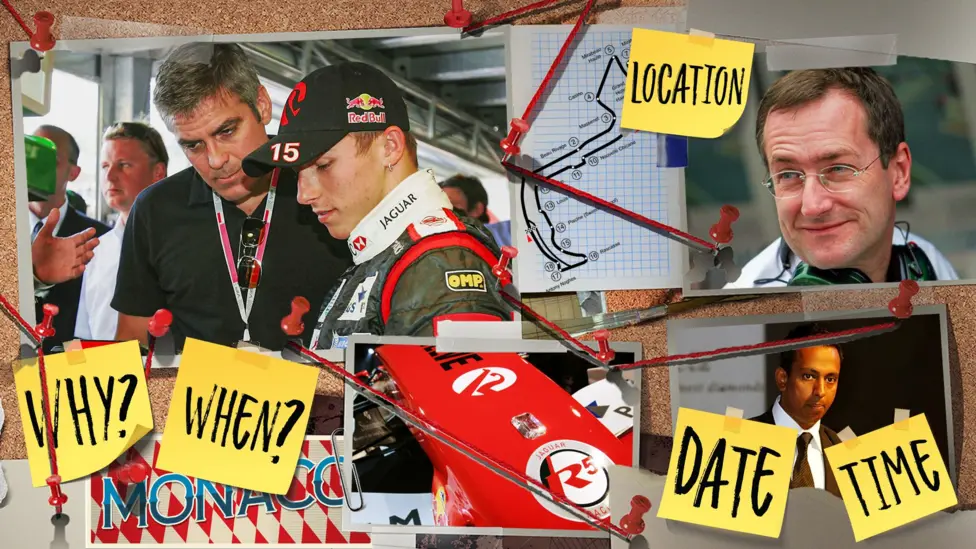
More than two decades later, one of F1’s strangest unsolved mysteries continues to fascinate fans. At the 2004 Monaco Grand Prix, a real diamond worth hundreds of thousands of dollars vanished after a first-lap crash. The gem was never recovered, and theories about its fate still circulate whenever the circus returns to the streets of Monte Carlo.
The Bold Publicity Stunt
In May 2004, Jaguar Racing found itself in a difficult position. The team was struggling for results and needed attention. To promote the upcoming Hollywood film Ocean’s Twelve, Jaguar partnered with Warner Bros. and diamond specialists Steinmetz. The plan was simple yet audacious: mount genuine diamonds on the nose cones of both team cars.
Each stone was a 1.4-carat diamond valued at approximately $250,000 to $300,000. The gems were set into the front of the cars driven by Mark Webber and rookie Christian Klien. Celebrities including George Clooney, Brad Pitt and Matt Damon attended the event, adding to the Hollywood glamour. The cars featured special red-and-white “Ocean’s Twelve” livery, turning the normally green Jaguar machines into rolling advertisements for a film about a high-stakes heist.
The stunt carried obvious risk. Monaco’s tight, unforgiving street circuit is notorious for accidents, especially on the opening lap. Jaguar accepted the danger as part of the story. Without an element of jeopardy, the promotion would have lacked impact.
The Crash That Changed Everything
Christian Klien’s race lasted only a few corners. On the first lap, the Austrian made contact with a Jordan car near the Mirabeau section. The impact damaged the front of his Jaguar. Shortly afterwards, Klien collided with the barriers at the famous Loews hairpin (also known as the Grand Hotel hairpin).
The car sustained nose damage. Marshals recovered the vehicle and moved it aside while the race continued. Safety protocols prevented the team from examining the car immediately. By the time Jaguar personnel could inspect the wreckage properly, more than an hour and a half had passed. The diamond was gone.
Mark Webber’s car retained its diamond for the early stages of the race before he retired with a mechanical issue. Only Klien’s gem disappeared.
Theories About the Missing Diamond
What happened to the diamond remains unknown. Several explanations have been put forward over the years.
One leading theory holds that the stone detached during the initial contact or the subsequent impact and was pocketed by an opportunistic spectator or track marshal. Within a short time after the race, the circuit reopened to the public. Hundreds or even thousands of people moved through the area. Jaguar’s then-communications director Nav Sidhu later stated he believed someone simply picked it up.
Another possibility is that the diamond lodged in the tyre barriers or was swept away with debris. Photographers who were close to the scene noted that the nose of Klien’s car already looked damaged before the final impact at Loews, suggesting the stone may have come free earlier on the lap. Some have speculated it could have fallen into a drain or been washed toward the harbour.
Rumours that the diamond was never real have been firmly rejected by those involved. Team principal Tony Purnell recalled that managing director David Pitchforth tested the stone by scratching a window with it—a traditional way to verify a diamond’s hardness. Sidhu and others have consistently maintained that genuine gems were fitted to both cars.
More fanciful suggestions have included an elaborate inside job or even involvement by the Ocean’s Twelve cast. These remain pure speculation and lack any supporting evidence.
The Aftermath and Lasting Legacy
Despite the loss, the stunt achieved its commercial goal. Media coverage was enormous. Newspapers and broadcasters around the world reported the story of the missing diamond, giving Ocean’s Twelve and Jaguar far more publicity than a conventional sponsorship arrangement would have generated. Sidhu later reflected that the team had been prepared for the possibility of losing the stone; otherwise they would never have taken the risk.
Jaguar exited Formula 1 at the end of the 2004 season. The team was sold and eventually became Red Bull Racing, which went on to become one of the most successful outfits in modern F1 history. The diamond episode remains one of the more colourful footnotes from Jaguar’s final years in the sport.
As of 2026, twenty-two years after the crash, the diamond has still not been found. No one has come forward claiming ownership, and no verified sighting has emerged. The mystery endures, resurfacing every time the Monaco Grand Prix approaches or when F1 fans dig into the sport’s quirky historical moments.
The episode highlights both the creativity and the unpredictability of Formula 1 promotions. Placing a high-value diamond on a racing car in one of the most crash-prone environments in motorsport was always a gamble. In this case, the gamble produced an unforgettable story—even if the jewel itself remains lost.
Whether the diamond sits in a private collection, lies forgotten in a Monaco drain, or was simply crushed beyond recognition, its disappearance has secured a permanent place in F1 folklore. The tale of the missing Monaco diamond continues to capture imaginations more than two decades later, proving that sometimes the greatest stories in racing have nothing to do with who crosses the finish line first.
Follow for real-time match analysis!🚀
Discover more from DeeplyticAI
Subscribe to get the latest posts sent to your email.