
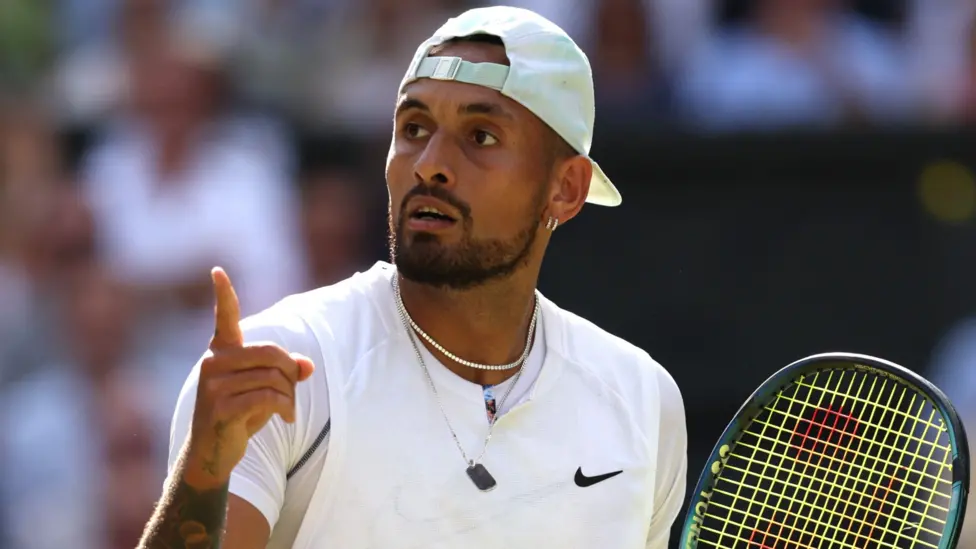
Nick Kyrgios has been provisionally suspended from professional tennis after testing positive for a metabolite of cocaine. The 31-year-old Australian provided a sample at the Mallorca Championships in June that was later confirmed to contain benzoylecgonine. The International Tennis Integrity Agency imposed the suspension on 4 August, and Kyrgios has not appealed it.
In a public statement, Kyrgios described the episode as a “huge mistake” for which he takes full responsibility. He apologised to fans, family, sponsors and especially to young people who look up to him. The development raises serious questions about the future of a career already heavily affected by injury and limited match play.
The Positive Test and Provisional Suspension
Kyrgios competed at the ATP 250 event in Mallorca in June 2026. He lost in the first round to fellow Australian Adam Walton. A sample collected during the tournament was analysed by a World Anti-Doping Agency-accredited laboratory, which confirmed the presence of benzoylecgonine on 17 July.
Cocaine is classified as a stimulant and a substance of abuse on the WADA prohibited list. It is banned in competition. Because the sample was taken during a tournament in which Kyrgios played, the case is being treated as an in-competition positive under the Tennis Anti-Doping Programme.
The provisional suspension prevents Kyrgios from playing, coaching or attending any events organised or sanctioned by the ATP, WTA, Grand Slams, World Tennis or national associations. The restriction remains in place until an independent tribunal rules on the case.
Potential Length of Ban
The eventual sanction will depend on several factors. If the tribunal finds that the substance was used intentionally and in competition, Kyrgios faces a ban of up to four years. Reduced penalties are available for substances of abuse when an athlete can demonstrate that the use occurred out of competition and was unrelated to performance enhancement. In such cases the maximum ban can fall to three months.
Kyrgios has not yet indicated whether he will argue that the use took place away from the event. The legal process is expected to take several months. Until it concludes, he remains unable to compete.
Impact of Recent Injuries and Limited Play
Kyrgios has struggled with persistent injuries for several years. Serious problems with his knee and wrist have restricted his schedule dramatically. Since the start of 2023 he has appeared in only a handful of tournaments and has won very few matches. In 2026 he had played just four singles matches before the suspension.
In his statement he spoke openly about the physical and mental toll. He said his body had been unable to match what his mind expected of it, and that coming to terms with the approaching end of his career had been harder than he imagined. The positive test and subsequent suspension arrive at a moment when he was already navigating the final phase of his playing days.
A lengthy ban would remove any realistic opportunity for a sustained comeback. Even a shorter suspension would interrupt whatever momentum he might have hoped to build. At 31, with a body that has already limited his availability, the practical window for returning to competitive tennis at a high level is narrow.
Career Context and Public Reaction
Kyrgios reached a career-high ranking of world No. 13 and contested the 2022 Wimbledon final. He has won seven ATP singles titles and built a reputation as one of the most talented and polarising figures in the sport. Injuries and off-court issues have repeatedly interrupted his progress, yet he has retained a significant following.
His decision to accept responsibility and step away from social media for 28 days to focus on personal recovery has been noted by observers. He described the episode as a wake-up call and said he intends to do the necessary work to return in a better state. Whether that return includes professional tennis remains uncertain.
The case also highlights the strict application of anti-doping rules. Previous players who tested positive for cocaine have received bans of varying lengths depending on the circumstances and their ability to prove the context of use. Kyrgios’ situation will be judged on the specific evidence presented to the tribunal.
What Happens Next
An independent tribunal will eventually hear the case and determine the final sanction. Until then the provisional suspension remains in force. Kyrgios cannot participate in any sanctioned events and has chosen to withdraw from public life for a period while he addresses personal matters.
For a player whose career has already been shaped by injury and inconsistency, the combination of a positive test and the resulting ban creates a significant barrier. A multi-year suspension would almost certainly bring his competitive career to a close. Even a shorter penalty would require a successful physical recovery and a renewed commitment at an age when many players begin to wind down.
Kyrgios has acknowledged the seriousness of his mistake and the example it sets. The coming months will determine whether tennis sees him on court again or whether the positive cocaine test marks the effective end of a turbulent and talented career.
